
Viewpoint by Vladislav Tsarkov

Abstract: Ensuring the diversification of gas supplies has become an important task for Europe since the outbreak of the conflict in Ukraine. Russian energy resources are subject to discriminatory trade policies. In these circumstances, Algeria’s role as one of the key gas suppliers to Europe is increasing. Simultaneously, the issue of the need to increase the share of renewable energy sources in the Algerian economy is frequently being raised. However, increased revenues from oil and gas exports may negatively affect the government’s desire to invest significant budget funds in the development of energy infrastructure for renewable energy sources. This article examines the strategic dilemma faced by the Algerian Government, choosing between maximizing the short-term benefits of exporting gas and oil and striving to switch to renewable energy sources. Based on up-to-date data, an assessment was made of the potential for reforms and barriers within the country to implement plans to diversify the energy sector. The article concludes that the current situation creates a historic opportunity for Algeria to carry out economic reforms aimed at diversifying the energy sector; however, to realize this opportunity, a high level of budgetary discipline will be required to make large-scale investments in new energy sources.
Keywords: Algeria, energy diversification, energy security, Europe, gas sector, infrastructure, oil and gas exports, reforms, renewable energy sources, sustainable development
Энергетический переход в Алжире: барьеры и возможности в условиях газового бума
Аннотация: Обеспечение диверсификации поставок газа стало важной задачей для Европы после начала конфликта вокруг Украины. Российские энергоносители подвергаются дискриминационной торговой политике. В этих условиях роль Алжира как одного из ключевых поставщиков газа в Европу возрастает. Параллельно с этим, все чаще поднимается вопрос о необходимости увеличения доли возобновляемых источников энергии (ВИЭ) в экономике Алжира. Однако возросшие доходы от экспорта нефти и газа могут негативным образом отразиться на желании правительства вкладывать огромные бюджетные средства в развитие энергетической инфраструктуры для ВИЭ. В настоящей статье рассматривается стратегическая дилемма, с которой сталкивается правительство Алжира, выбирая между максимизацией краткосрочной выгоды от экспорта газа и нефти и стремлением к переходу к возобновляемым источникам энергии. На основе актуальных данных была дана оценка потенциала реформ и барьеров внутри страны для реализации планов по диверсификации энергетического сектора. В статье делается вывод о том, что текущее положение создает для Алжира историческую возможность для проведения экономических реформ, направленных на диверсификацию энергетического сектора, однако для реализации данной возможности потребуется высокий уровень бюджетной дисциплины для осуществления крупномасштабных инвестиций в новые источники энергии.
Ключевые слова: Алжир, возобновляемые источники энергии, газовый сектор, диверсификация энергетики, Европа, инфраструктура, реформы, устойчивое развитие, экспорт нефти и газа, энергетическая безопасность
Introduction
The conflict in Ukraine has led to European countries setting the goal of radically cutting off Russian energy imports as an element of sanctions pressure against Russia. However, Europe’s gas needs remain consistently high, which creates good opportunities for other global energy market players to expand the volume of gas supplies to the EU. In these circumstances, the role of Algeria, the second most important supplier of gas to Europe, is radically increasing. This is reflected in the increased number of visits to Algeria by senior Western officials such as former Italian Prime Minister Mario Draghi and former US Secretary of State Antony Blinken. One of the results of such meetings is a $4 billion deal to increase gas supplies to Italy in 2022.[1]
However, behind this success there are potential risks for Algeria’s economy, which has been dependent on oil and gas exports for decades, accounting for over 90% of its export revenue. In 2022, Algerian state oil and gas company Sonatrach reported record-breaking revenue of around $60 billion.[2] It provides financial opportunities for the country, but it also reduces the motivation to implement long-overdue structural reforms. Algeria is now at a crossroads: should it embrace a new wave of dependence on the oil and gas sector, or invest these revenues in green energy?
Current State of the Energy Sector
Algeria emerged as a global energy power in the mid-20th century, following the discovery of several large oil and gas fields in the country. Currently, it has significant pipeline infrastructure connecting it to Southern Europe, which serves as its primary export route. In 2023, Algeria’s crude oil exports amounted to approximately 480,000 barrels per day (bpd), establishing itself in 19th place in the world. Additionally, gas exports amounted to 51 billion cubic meters (bcm) per year, which is 7th place in the world.[3] However, several studies have shown that energy consumption in Algeria has increased by 42% over the past decade largely due to industrial growth, while energy production has only increased by 12%, undermining its export potential.[4] The problem is also exacerbated by the fact that energy losses increased by 11% in 2023, indicating problems with the state of critical energy infrastructure. If the current trends continue, gas reserves may be depleted within the next 20 years.[5]
Figure 1. Structure of Commercial Primary Energy Production in Algeria, 2024
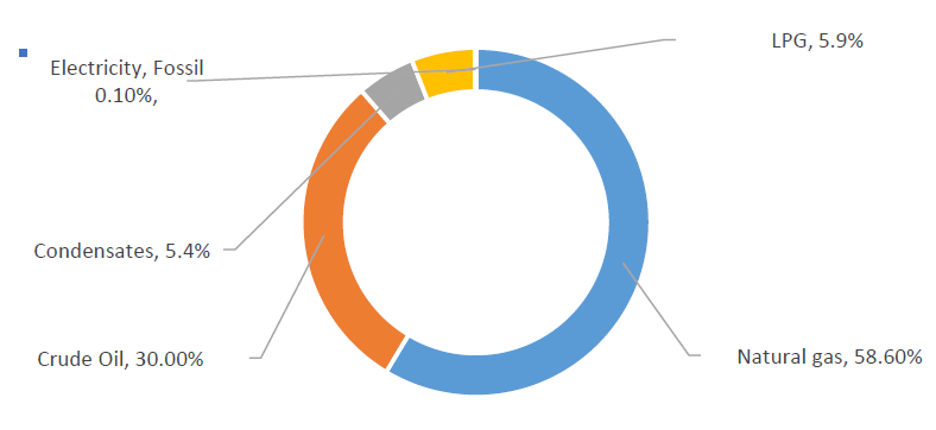
Source: “Algeria’s Energy Transition: A Critical Assessment for a Sustainable Future”[6]
Renewable Energy Development Prospects
At the same time, Algeria also has enormous potential in the field of renewable energy sources. For example, in most regions of the country, there are more than 3,000 sunlight hours per year, and the potential for wind power generation is estimated at 8,000 GW, making Algeria one of the leaders in Africa.[7] According to Algerian researcher A. Noureddine, investments in renewable energy can help the country achieve its sustainable development goals in three areas: environmental protection, social, and economic development.[8] The greatest benefit of solar power generation may be in providing electricity to regions of Algeria that are far from the Mediterranean Sea and have limited access to traditional sources of electricity.
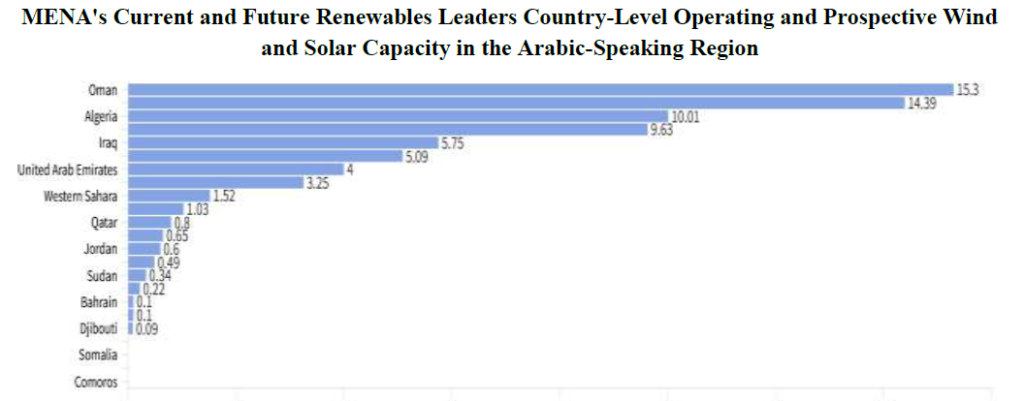
Source: “The Transition to Renewable Energy Economies and Its Role in Achieving Sustainable Development in Algeria”[9]
It is worth mentioning that the Algerian authorities are paying special attention to this issue, and structural reforms have been initiated to realize this potential. First of all, the Ministry of Energy Transition and Renewable Energy was established in 2020, and regulatory reform was carried out to liberalize the electricity market, opening it up to small and medium enterprises (SME) in the field of renewable energy. Additionally, the national company SHAEMS was established under the supervision of the Ministry, which will also operate in the field of renewable energy. The overall goal is to achieve 30% of the country’s total electricity generation from renewable sources by 2030. The Solar1000 program, which involves annual tenders for 1,000 MW of solar capacity, should play a key role in this.
Despite these advantages, the prospects for the energy transition in Algeria cannot be unequivocally assessed positively. Firstly, the program to increase the share of renewable energy involves the introduction of 22 GW of capacity by 2030, half of which is expected to be exported, but by 2021, the total installed capacity of renewable energy in Algeria was only 0.5 GW.[10] Secondly, a good example of the implementation of these tenders is the case from 2019, when only 90 MW of the planned 150 MW of solar capacity was submitted, due to strict local requirements and financing.[11] Subsequently, these requirements were relaxed, but bureaucratic pressure within the sector remains. Additionally, record-breaking revenues from hydrocarbon exports may significantly reduce the fiscal urgency of implementing necessary reforms in the renewable energy sector.[12] As noted by M. Hochberg and S. Boukaila, “renewable energy investment is often viewed with a degree of skepticism in Algeria and requires a high upfront investment cost (albeit with zero fuel cost and low operation and maintenance costs), with benefits that are perceived as uncertain. This dynamic, coupled with Europe’s urgent need to import more gas, collective anxiety regarding an accelerated energy transition, and the concern of future stranded hydrocarbon assets, helps shift attention away from renewable energy deployment toward further expansion of hydrocarbons”.[13]
In addition, one of the key barriers to the further expansion of renewable energy projects is the fierce competition with fossil fuels in the domestic market. This is evident by the subsidized prices for gas, which is the primary fuel for electricity generation, making it difficult for cost-effective renewable energy sources to compete with traditional ones. Moreover, the existing electricity grid system, which is designed to accommodate large-scale fossil fuel-based power plants, would require significant adaptation and infrastructure upgrades while integrating decentralized renewable energy sources.
Conclusion
The factors involved in the Algerian energy dilemma show that the issue of switching to renewable energy sources is a much more complex matter for Algeria. It is difficult to fully justify projects in this area for political purposes. Renewable energy is key to Algeria’s long-term economic development and its sustainability in the energy sector. However, in this case, ideological aspects cannot serve as a basis for transition. Instead, the approach must be purely pragmatic and economically sound. Investments in the renewable energy sector are a necessary, albeit complex, infrastructure and economic project, where long-term benefits rather than short-term profits come to the fore.
Environmental issues cannot be the key argument in favor of an energy transition for a country like Algeria, since they are caused by problems in the economic sphere and energy security. Additionally, the growing domestic gas consumption may create serious macroeconomic risks for the budget, because each subsidized cubic meter of gas in the domestic market could be sold internationally at higher prices or used in industry, while domestic electricity generation for civilian consumption could rely more on the country’s competitive advantages in solar and wind energy.
Therefore, the introduction of new energy sources will maximize the benefits for the country’s economy and have a positive impact on further development. On the other hand, this transition, as already mentioned, will require huge investments in infrastructure development, which is inherently a financial barrier. However, there must be a more balanced cost estimate. The continued use of the current model will further exacerbate the problem of inefficient use of energy, as well as reduce export revenue in the future.
These investments can serve as insurance against emerging problems that may cost the Algerian economy significantly more than what the development of renewable energy infrastructure requires. In essence, it implies the following general concept: Algeria’s government should be more disciplined in the use of excess revenues from oil and gas exports, and these funds should also, among other things, be invested in building a new, diversified economy.
The current boom caused by the geopolitical situation creates a historic window of opportunity for Algeria, which must be used to make the transition. By missing this opportunity, the Algerian government will undermine the future significance of the state in a world in which fossil fuels will slowly lose their monetary and strategic value. The evolutionary, rather than revolutionary, path of expanding the share of renewable energy in the Algerian economy is the main reasonable way to ensure the country’s sustainable development for decades.
About Vladislav Tsarkov
Vladislav Tsarkov is a Master’s student at the Faculty of Economics of St. Petersburg State University, Department of World Economy.
Address for correspondence:
tsarkav2@mail.ru
[1] “Italy Signs Energy Deals with Algeria in Bid to Sidestep Russia,” Al Jazeera, July 19, 2022, https://www.aljazeera.com/news/2022/7/19/italy-signs-energy-deals-with-algeria-in-bid-to-sidestep-russia.
[2] “Algerian Oil and Gas Company Sonatrach Earned $60 Billion in Exports in 2022,” Gazeta.ru, March 26, 2023, https://www.gazeta.ru/business/news/2023/03/26/20063179.shtml.
[3] “Trade Map,” International Trade Centre, accessed October 25, 2025, https://www.trademap.org.
[4] Omar Kebour et al., “Algeria’s Energy Transition: A Critical Assessment for a Sustainable Future,” International Journal of Environmental Sciences 11, no. 7s (2025): 366, https://theaspd.com/index.php/ijes/article/view/1342
[5] Ibid, p. 373
[6] Ibid, p. 371.
[7] Michael Hochberg and Samy Boukaila, “Algeria’s Potential as an Integrated Energy Nation,” in Energy Politics in the MENA Region: From Hydrocarbons to Renewables?, ed. Valeria Talbot (Milan: Ledizioni LediPublishing, 2022), 35-36.
[8] Abdelkader Noureddine, “The Transition to Renewable Energy Economies and Its Role in Achieving Sustainable Development in Algeria,” Dirassat Journal Economic Issue 16, no. 2 (2025): 85.
[9] Ibid, p. 93.
[10] Ibid., p. 94.
[11] Michael Hochberg and Samy Boukaila, “Algeria’s Potential as an Integrated Energy Nation”: 40.
[12] “Middle Eastern Countries are Sitting on an Ocean of Natural Gas,” The Economist, October 13, 2022, https://www.economist.com/middle-east-and-africa/2022/10/13/middle-eastern-countries-are-sitting-on-an-ocean-of-natural-gas.
[13] Michael Hochberg and Samy Boukaila, “Algeria’s Potential as an Integrated Energy Nation”: 45.