
Analysis by Kasiet Toktogulova

Abstract: This study examines the role of small- and medium-scale innovative technologies in the modernization of Kyrgyzstan’s energy sector. Despite the dominance of hydropower in electricity generation, the country faces serious seasonal shortages, outdated infrastructure, and high levels of winter air pollution caused by coal and biomass use for heating. The paper analyzes several examples of innovation across different levels of the energy system: a stove filter high-efficiency low-emission (HELE) stoves, a Light Detection and Ranging (LiDAR) unit for wind resource mapping, and projects for the modernization of small hydropower plants. These technologies were chosen for their potential to address the country’s key challenges — emission reduction, energy diversification, and improved reliability of supply. The study identifies barriers to wider adoption of innovations, including financial constraints, fragmented regulation, technical challenges, and limited public awareness. It concludes by emphasizing the need for an integrated state policy aimed at supporting local innovations, strengthening institutional coordination, and encouraging investment. The case of Kyrgyzstan may also inform other countries such as Tajikistan, Uzbekistan, Mongolia, and Nepal, which face similar seasonal and environmental challenges.
Keywords: air pollution, clean energy transition, energy policy, heating, hydropower, innovation, Kyrgyzstan, renewable energy, small-scale technologies, sustainability
Инновации для чистой энергии: новые технологии и их влияние на модернизацию энергетики в Кыргызстане
Аннотация: Данное исследование рассматривает роль малых и средних инновационных технологий в процессе модернизации энергетического сектора Кыргызстана. Несмотря на доминирование гидроэнергетики в структуре производства электроэнергии, страна сталкивается с серьёзными сезонными дефицитами, устаревшей инфраструктурой и высоким уровнем загрязнения воздуха в зимний период из-за использования угля и биомассы для отопления. В работе анализируются несколько примеров инноваций на разных уровнях энергетической системы: фильтр для печей, высокоэффективные мало-загрязняющие (HELE) печи, установка устройств «Светового обнаружения и определения дальности» (LiDAR) для картирования ветровых ресурсов и проекты по модернизации малых гидроэлектростанций. Эти технологии выбраны за их потенциал решать ключевые задачи страны — снижение выбросов, диверсификация источников энергии и повышение надёжности энергоснабжения. Исследование выявляет барьеры, препятствующие широкому внедрению инноваций, включая финансовые ограничения, фрагментированное регулирование, технические сложности и низкий уровень информированности населения. В заключение подчеркивается необходимость комплексной государственной политики, направленной на поддержку локальных инноваций, координацию институтов и стимулирование инвестиций. Опыт Кыргызстана может служить примером для других стран, таких как Таджикистан, Узбекистан, Монголия и Непал, которые сталкиваются с аналогичными сезонными и экологическими вызовами.
Ключевые слова: возобновляемые источники, гидроэнергетика, загрязнение воздуха, инновации, Кыргызстан, технологии малых масштабов, отопление, энергетическая политика, энергетический переход, устойчивое развитие
Introduction
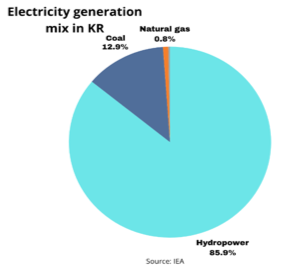
Kyrgyzstan’s energy security is at a crossroads as it tries to balance environmental sustainability with energy security in Central Asia. The country depends on domestic hydropower for almost 90% of its electricity generation, and it faces issues such as seasonal imbalances, aging infrastructure and limited diversification.[1] The energy challenges reach their peak during winter because electricity consumption for heating rises while the country relies more heavily on coal and biomass to bridge power gaps.
The combination of polluting fuels used in urban areas and rural homes has created an escalating public health emergency and environmental disaster. The residential heating activities, especially in Bishkek, generate severe air pollution that affects the city during winter months. The energy sector of Kyrgyzstan appears environmentally friendly in official documents, yet most of its current emissions stem from inefficient household heating systems.
In this situation, the growing importance of decentralized clean and affordable energy innovations emerges. The implementation of such technologies as mechanical stove filters, HELE stoves, wind resource mapping tools and modernized small hydropower systems provides context-specific alternatives for small- and mid-scale technologies. The solutions need minimal infrastructure changes, yet lead to significant effects, and can be implemented step-by-step which makes them suitable for political approval and social expansion. They leverage local knowledge and regional best practices to connect national policy with community requirements.
The article examines the impact of these innovations on Kyrgyzstan’s energy modernization process. The research examines how clean technology success or stagnation depends on the interaction between technical performance, policy alignment, cost and scalability factors. The research reveals essential obstacles to adoption through structural and behavioral barriers while providing specific recommendations for policy transformation, financial support, and regional collaboration. It demonstrates how innovation ecosystems supported by effective measures can create practical solutions for developing cleaner and more resilient energy systems during a period when Kyrgyzstan faces among the worst winter air quality in the world.
Background and Review of Key Literature
The energy system of Kyrgyzstan depends mainly on hydropower which generates about 90% of the country’s total electricity.[2] The country stands out as one of the ‘greenest’ in the region because of its power generation mix. However, this makes it very vulnerable to major seasonal challenges. The generation of hydropower depends heavily on water supply, which decreases dramatically during winter months when heating requirements for homes reach their peak. The seasonal power supply gap leads people to use solid fuels including coal and wood for heating their homes (Figure 1)[3] particularly in peri-urban and rural areas, which results in serious air pollution and energy instability.
Figure 1. Electricity Generating Mix in Kyrgyzstan
Source: IEA, 2022
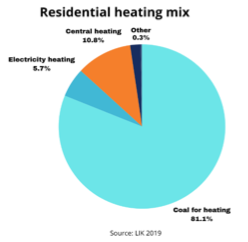
The extensive use of coal for heating, illustrated in Figure 2,[4] particularly in the capital Bishkek has resulted in Central Asia’s highest wintertime air pollution levels. The heating sector end-use energy practices generate 47% of greenhouse gas emissions and toxic air pollutants like PM2.5 despite electricity production appearing clean on paper (Figure 3).[5] The Asian Development Bank together with local monitoring agencies have documented that Bishkek’s winter pollution exceeds World Health Organization safety standards by 20-30 times which creates severe health dangers for the public.[6]
Figure 2. Residential Heating Mix
Source: LIK, 2019
Figure 3. PM2.5 Pollution by Source

Source: ADB
The obvious environmental and health expenses have little bearing on Kyrgyzstan’s energy policy in choosing clean household energy practices. The market has not seen many technologies reach mass production levels and innovation systems operate independently from each other. The literature proves that small- and medium-scale technologies play a crucial role in connecting centralized infrastructure to actual household requirements.
According to the World Bank’s 2020 report Fueling Kyrgyzstan’s Transition to Clean Household Heating Solutions, stoves in villages tend to be dual-purpose in more than a third of Kyrgyz households. The stoves are used for heating rooms and providing a kitchen flame in which to cook. This dual use makes coal, wood, and dung especially appealing. Subsequently, it results in not only outdoor but indoor air pollution. The report further emphasizes the potential of high-efficiency, low-emission (HELE) heating technologies, by highlighting the health and climate costs of coal-based household heating and presents early examples of efficient stove technologies piloted in the Kyrgyz communities.[7]
Laldjebaev et al. point out that the Central Asian region has considerable untapped potential in both solar and small hydropower, but that legal and financial barriers are the main obstacles to wider deployment. Their study shows that many renewable energy initiatives in the region fail because of fragmented institutional mandates, inconsistent policy support, and lack of long-term financing mechanisms.[8] Similarly, the International Energy Agency recognizes that although hydropower leads the national electricity mix, the country uses only a small portion of its available potential and solar and wind power development remains restricted.[9]
The World Bank assessment reveals that the country possesses 87 feasible Small Hydropower Plant (SHP) sites which amount to more than 180 MW of potential capacity and most of these sites generate electricity at lower costs than the Bishkek Combined Heat and Power (CHP) plant.[10] Additionally, Omorov and Rakhimov’s analysis shows that more than 70% of the country’s hydropower potential exists in small rivers located in rural and highland regions that receive limited national grid service.[11] The projects present dual advantages because they create less environmental impact while matching well with decentralized energy planning and rural electrification needs. The legal and financial barriers have not stopped SHPs from becoming a promising solution to expand power generation while improving grid stability and decreasing dependence on fossil fuels during seasonal shortages (Figure 4).[12]
Figure 4. Small HPP Supply Curve

Source: World Bank, 2017
The energy strategy of Kyrgyzstan recognizes these limitations. The 2010–2025 National Energy Program established the base by focusing on the renewal of aging energy infrastructure, production and distribution of efficiency improvements as well as energy market liberalization.[13] The government built upon this framework by adopting the 2023–2027 Program for the Implementation of Energy Saving and Energy Efficiency Policy which focuses on better energy resource management, organizational and technical measures to boost end-use efficiency.[14] However, its implementation has been uneven.
The literature reveals a significant lack of integration between bottom-up, locally driven innovations and national policy frameworks, particularly in Kyrgyzstan with limited institutional support. Despite substantial attention to large-scale energy reforms, including the National Energy Program and Strategy for Fuel and Energy Sector, it has limited analysis on the local low-cost scalable innovations. For instance, the 2024 cyclone-type mechanical stove filter remains unassessed by academic research despite the official government confirmation of its emissions reduction performance.[15]
The research area lacks studies that examine how different innovation levels interact with each other such as studies combining household technologies with resource assessment tools or infrastructure upgrades. The behavioral and institutional factors that influence clean technology adoption would require further investigation.
Methodology
This research uses qualitative multi-scale case study methods together with the desk-based content analysis of secondary sources. The research specifically examines the small- and medium-scale technologies which solve the dual problems of energy access and air pollution.
The paper investigates energy modernization through an analysis of innovations at three different levels: household, infrastructure and governmental/strategic levels. The research uses a multi-scale analytical approach to identify both technical performance and institutional, behavioral and policy-level factors that affect the deployment and sustainability of clean technologies.
Case Study Selection
The research includes four case studies: locally-built smoke filter for coal stoves, HELE-stove Systems, a LiDAR wind measurement unit, and a small hydropower plant upgrade and expansion. These demonstrated various innovation types and technology scales and their connection to Kyrgyzstan’s energy modernization and air quality targets, outlined in the National Development Strategy of the Kyrgyz Republic for 2018–2040[16] and the Plan of Priority Measures to Improve Air Quality in Bishkek City for 2024–2025.[17] The selected cases demonstrate the range of the small to medium technology solutions which address Kyrgyzstan’s immediate energy needs, including winter air pollution, seasonal power outages and energy diversification beyond hydropower. Additionally, they provide policy-relevant potential and are sufficiently documented to be subject to systematic analysis. The study excluded rooftop solar and biogas and geothermal initiatives because they exist only in experimental phases throughout Kyrgyzstan or lack sufficient data for thorough assessment. Rooftop solar projects are mostly restricted to donor-funded pilot projects, whereas biogas projects are only found in small rural pilot projects with little uptake. Most geothermal resources in Kyrgyzstan are low-temperature resources, intended to be used in spas or local heating, providing few grounds on which to organize systematic comparison. Therefore, the research focuses on four specific examples mentioned, which demonstrate how energy modernization can be achieved through context-based solutions that show broader implementation potential. Selection criteria included policy relevance, scalability, and data availability. Each innovation had to be operationally tested or documented, context-specific to Kyrgyzstan, and demonstrate measurable contributions to energy modernization or emission reduction. Table 1 below presents the overview of the chosen innovations and reasons for their inclusion.
Table 1. Overview of Selected Innovations and Rationale for Inclusion to the Analysis
| Innovation | System Level | Key Challenge Addressed | Reason for Inclusion | Reason for Exclusion of Alternatives |
| Cyclone-type Mechanical Stove Filter | Household / End-use | Winter air pollution, household health | Locally developed, affordable, and context-specific solution with proven emission reductions | Alternatives like biogas stoves excluded due to limited pilot scale and insufficient documentation |
| HELE Stove Technologies | Household / End-use | Inefficient heating, high GHG and particulate emissions | Demonstrates how international donor-supported innovation could work in Kyrgyzstan | Excluded solar rooftop heating due to marginal adoption and lack of pilot evidence |
| LiDAR Wind Mapping | Strategic / Planning | Seasonal shortages, lack of diversification | Provides enabling data for wind energy planning, reduces investment risks | Other planning tools (geothermal mapping) not yet deployed in Kyrgyzstan |
| Small Hydropower Modernization | Infrastructure / Generation | Limited rural electrification and seasonal dependence on large hydropower. | Expands clean energy access with relatively low environmental impact | Large hydro excluded as outside “small/medium-scale” scope |
Source: Compiled by the Author
Data Collection and Sources
The research uses publicly available secondary data from major international development institutions including the Asian Development Bank, World Bank and International Energy Agency. The study draws on project documentation and official statements from key stakeholders such as USAID, Kyrgyzpatent and the Ministry of Energy of the Kyrgyz Republic to understand recent innovation deployments and policy developments. The analysis is further supported by academic literature on regional renewable energy trends and air pollution mitigation strategies as well as media coverage of locally developed technologies. The study includes interview material and field data from existing case evaluations when available to understand the real-world performance and implementation challenges.
Case Studies
Cyclone-type Mechanical Filter for Coal Stoves (2024)
According to article reports, Bishkek-based hydraulic engineer Amantur Salymbaev created a mechanical smoke filter for traditional coal stoves: a local solution to address Kyrgyzstan’s winter air pollution emergency during early 2024. The filter developed by Salymbaev operates as a household energy tool, since it maintains a compact design and operates autonomously while working with standard stove equipment. The device operates without electricity or water supply which makes it an ideal solution for both off-grid and low-income households.
The engineer obtained a patent from Kyrgyzpatent after conducting prototype testing. The Ministry of Natural Resources and its Department of Environmental Monitoring performed laboratory tests which showed that the device could remove more than 70% of soot and greater than 90% harmful smoke particles, including some CO2 emissions.[18] The installation of six filters in Bishkek households was reached in 2025. Users have given positive feedback about the device. It is reported to reduce visible smoke, improve indoor air quality and remain simple to operate. The filter features a mechanical structure which enables users to clean and reuse it without needing any specialized maintenance.
The initiative operates at a small-scale production level while remaining independent from official air-quality and efficiency programs. The filter’s expansion requires government backing together with mass production capabilities and increased public understanding in order to achieve its maximum health and climate benefits. The stove filter demonstrates how local innovation can create context-specific solutions. The solution has strong potential to deliver high impact because it meets public health requirements, climate targets and household energy demands. The development of this technology requires institutional, financial and communication support.
HELE Stove Technologies
The HELE stove technologies provide another compelling example of effective household energy solutions. It was introduced through limited pilot programs in Kyrgyzstan in 2019 by the United Nations Development Program (UNDP) and the World Bank. The stoves achieve better combustion efficiency and lower household fuel usage through the optimized air flow, insulation and combustion chamber design. The HELE systems achieve the best results in reducing fine particulate matter (PM2.5) emissions with a 30% to 70% reduction based on the model type and user practices.[19]
However, the HELE solutions often involve partial system replacement or modification to ensure compatibility with high-efficiency combustion chambers, and they are usually imported or assembled with higher specification materials. This makes them more expensive in terms of the unit price and installation, but potentially more durable and fuel-efficient in the long term.
Despite the achievements of neighboring Central Asian countries’ documented health gains, Kyrgyzstan has not adopted these improvements because of the limited affordability, low consumer awareness, and lack of national standards or subsidies. The HELE distribution system depends almost exclusively on the donor-funded projects which demonstrates the requirement for policy tools that will drive broader market adoption.
USAID’s LiDAR Wind Mapping Deployment (2025)
The Ministry of Energy in Kyrgyzstan obtained its initial LiDAR unit through the USAID’s Power Central Asia initiative during May 2024.[20] The advanced remote sensing device uses laser pulses to measure wind speed and turbulence at different heights while providing portable and economical solutions instead of the traditional meteorological masts. The deployment of this technology represents a major advancement for wind energy planning in Kyrgyzstan because it addresses the country’s unexplored wind resources and challenging mountainous landscape.
The LiDAR unit produces the precise high-resolution wind resource data that enables the identification of the best wind farm locations, reduction of investment risks and improvement in financial predictions. The wind resources are more abundant during winter months, which in turn supports Kyrgyzstan’s objective to diversify its energy mix beyond hydropower and address seasonal power shortages.
Although the implementation of LiDAR does not entail significant infrastructure, its data can be used to proceed to the next phases of renewable development, including the building of wind farms and the integration of the grid, which in turn would require considerable investments and organization. However, the technology represents an important preparatory phase that increases bankability of a project and provides the necessary conditions in advance of the involvement of the private sector involvement in utility-scale wind energy.
Small Hydropower Modernization and Expansion in Kyrgyzstan
The government of Kyrgyzstan works to increase its SHP capacity because it wants to improve energy stability and decrease its need for large-scale hydropower. The national power grid received 48.84 MW of the new capacity through the commissioning of eight SHPs in 2024.[21] The Uzbek Kyrgyz Development Fund supported the completion of the 9.6 MW Kainama SHP in Jalal-Abad and the 6.8 MW Kok-Art SHP in the Suzak District in 2024. The construction of the 25 MW Papan SHP in the Osh Region and the 21 MW Orto-Tokoy SHP in the Issyk-Kul Region has started, and the latter will power more than 14,000 consumers in Balykchy.[22]
The Lebedinovka SHP will begin its modernization process in 2025. The Lebedinovka HPP in Kyrgyzstan operates as a small hydropower plant which was built during the Soviet era as part of the Alamedin HPP cascade. The Lebedinovka SHP modernization project aims to boost station power output from 7.6 MW to 9.2 MW while increasing yearly electricity generation by 56% to reach 53.5 million kWh. The modernization project will enhance operational reliability by 90% while extending the plant’s operational period by 30–40 years.[23]
The Kyrgyzstan government plans to build 18 more SHPs beginning in 2025 to enhance power supply in the distant and mountainous regions. SHPs provide benefits including minimal environmental effects and compatibility with decentralized power systems and faster implementation than big hydropower projects. The recent positive trends show a strategic move toward incorporating SHPs into Kyrgyzstan’s diverse energy mix.
Multi-Scale Comparison
The selected innovations represent distinct intervention levels within Kyrgyzstan’s energy system: household, infrastructure and governmental/strategic levels. The multiple dimensions of analysis show that clean energy transition occurs through both major capital-intensive reforms and low-cost decentralized innovations and enabling tools. (Table 2)
Table 2. Multi-Scale Comparison by Solution
| Innovation | Type of Impact | Emissions Reduction | Cost Level | Scalability | Policy Integration |
| Smoke Filter for Stoves | Air quality, health | High (up to 90% harmful particles) | Low | Medium | Low (no state program) |
| HELE Stove Technologies | Efficiency, health, fuel use | Medium–High (30–70% PM2.5) | Medium | High | Medium (pilot projects only) |
| LiDAR Wind Mapping Unit | Wind site optimization | Indirect (enables RE) | Medium | High | Medium (Gov–donor linked) |
| SHP Modernization (Lebedinovka) | Grid efficiency, clean electricity | Medium (hydro upgrade) | High | Medium | Medium (project-based) |
Source: Compiled by the Author
These innovations form a multi-scale approach to clean energy transition which includes end-use household interventions, planning-level enabling technologies and modernized grid-connected generation assets.
The stove filter created by Salymbaev provides an accessible affordable solution to address Kyrgyzstan’s winter indoor and outdoor air pollution problems. The device works well for low-income households because it is affordable and easy to use but its impact remains limited because of production restrictions and no state backing. The introduction of HELE stoves through donor-funded pilot projects has proven successful because these stoves cut particulate emissions up to 70% through their advanced combustion systems. The long-term potential of HELE stoves is high; however, their effectiveness is limited by the need for complete replacement of the current units and its expensive price point. The two technologies demonstrate that a multi-level strategy should use quick-to-deploy low-cost retrofits alongside advanced high-efficiency solutions for sustainable clean heating systems.
The LiDAR wind measurement system operates at the strategic planning scale to support long-term renewable energy investments through the enhanced wind resource assessments. The system creates an essential base for utility-scale clean energy development which will help Kyrgyzstan join regional power markets in the future. The system requires both institutional adoption and active wind developer presence to achieve its effectiveness.
Likewise, the infrastructure sector demonstrates the potential of small hydropower (SHP) plants through the recent investments for decentralized clean electricity generation. The SHP sector experienced eight new installations during 2024 while the Lebedinovka SHP modernization project will enhance operational efficiency and capacity; and extend the facility’s operational lifespan. The implementation of SHPs is essential for rural and mountainous areas because central grid extension proves both expensive and unreliable in these regions. The low environmental footprint and flexible design of SHPs enable them to support both major hydropower facilities and provide electricity services to remote locations.
Barriers to Adoption
The technical potential of the new clean energy solutions in Kyrgyzstan does not translate into broad market adoption. The four case studies in this paper—Salymbaev’s stove filter, HELE stove technologies, the LiDAR wind assessment unit, and ongoing small hydropower developments — reveal a shared set of barriers: financial, institutional, technical, and behavioral. These constraints slow progress on air quality, energy diversification, and rural access improvements.
Financial and Market Limitations
The financing gap represents a major challenge for Salymbaev’s filter and small hydropower upgrades. Locally developed or small-scale technologies face challenges to progress beyond prototypes because they lack access to concessional finance or public investment. Extended payback times and high capital expenses, particularly in cases without specific financial tools like feed-in tariffs or green innovation funds, make private participation difficult.
Regulatory and Institutional Gaps
The energy governance system in Kyrgyzstan operates through various agencies which create overlapping responsibilities and have poor coordination between them. The approval process for technology takes longer because of this fragmentation, preventing many innovations including the stove filter from receiving certification or subsidy programs. The LiDAR unit remains underutilized, since the country lacks both national wind planning protocols and project development pipelines.
Technical and Logistical Challenges
For SHP and distributed renewables particularly, the deployment of technology in remote or mountainous areas presents major logistical difficulties. The integration of the small-scale renewables is filled with challenges because of the weak grid infrastructure, insufficient battery storage and limited technical planning capacity. SHPs are more promising; however, their implementation becomes challenging because of the transportation and maintenance issues in remote areas.
Behavioral and Awareness Barriers
The adoption process depends on both trust and awareness levels. Traditional stoves remain in use because people stick to familiar practices. The lack of knowledge about new alternatives and intrinsic doubt about unfamiliar technologies are the main behavioral barriers. The HELE stoves and Salymbaev’s filter solutions remain marginalized because there are no public demonstrations and local outreach or government endorsement.
Lack of Coordinated Policy Support
The national strategies include diversification and efficiency, but there are no policies supporting clean energy innovation. Moreover, dedicated subsidies, incubators, or incentive schemes for small-scale technologies are nonexistent. The formal energy system does not support innovations with high potential since they operate outside its boundaries without any scaling assistance.
Policy Recommendations
Small- and medium-scale energy innovations in Kyrgyzstan need more than technical solutions because they require a policy environment that supports adoption, financing, and institutional integration. The current 2023–2027 Program for Energy Saving and Efficiency Policy of the country presents a vision for better energy performance, yet it does not provide specific tools to support decentralized technologies including Salymbaev’s stove filter, high-efficiency stoves and small-scale renewables.
The implementation of certified clean heating technologies requires immediate inclusion in the national energy efficiency and air quality programs. For example, Salymbaev’s filter which was developed locally should become a part of the subsidy schemes, low-income housing programs and public procurement initiatives. The implementation of community-level demonstration projects would also help in building trust while making sustainable alternatives more acceptable to households that currently rely on coal or biomass.
Equally important is the creation of a unified testing and certification system for new clean technologies. The current patent processing delays combined with the absence of emissions verification and technical validation systems create challenges for inventors. A Clean Energy Testing and Innovation Lab located at the public university under Ministry of Energy co-management would function as a national center for product evaluation and emissions testing and technology certification registry. The establishment of this system would decrease adoption risks while attracting public funding and fostering partnerships between innovators, regulators and donors.
Furthermore, the elimination of financial obstacles stands as a vital objective. Clean energy entrepreneurs together with pilot projects face challenges to obtain funding which prevents them from advancing past their prototype development phase. A Green Innovation Fund should provide concessional financing for small-scale technologies to address this funding gap. The Asian Development Bank (ADB) and European Bank for Reconstruction and Development (EBRD) should partner to provide loan guarantees and blended finance tools for investments in small hydropower, solar-plus-storage systems and heating system upgrades. Tax exemptions together with customs relief for clean energy components would reduce costs for both local producers and consumers.
Finally, the energy transition in Kyrgyzstan needs to be handled as a cross-sectoral and regional agenda. The ministries of energy, environment and public health should coordinate more closely at the national level in developing municipal energy and climate action plans, especially for the high-emission cities like Bishkek and Osh.
Conclusion
The energy transition in Kyrgyzstan takes place during a period when environmental pressures, climate change vulnerabilities and social challenges are becoming more severe. The energy sector faces structural weaknesses since hydropower remains the main electricity source, while seasonal power imbalances, outdated infrastructure and solid fuel heating for winter months persist. Subsequently, the country faces its worst winter air pollution problems which create significant health dangers and obstruct long-term development targets.
The research analyzed various emerging technologies operating at different stages of the energy system to provide practical scalable solutions for these problems. The mechanical stove filter developed by Salymbaev represents a locally made innovation by showing how affordable retrofit technologies can decrease particulate pollution and at the same time enhance indoor air quality at residential level. Additionally, small hydropower projects that use new and modernized technology would enhance grid resilience and provide clean electricity access to rural areas that lack proper infrastructure. Finally, the strategic planning level would benefit from the LiDAR wind resource mapping technology which enables the development of new power sources and attracts clean energy investors to Kyrgyzstan.
Nevertheless, technical potential and contextual value of these innovations face obstacles in their widespread adoption because of financing gaps, regulatory fragmentation, weak planning systems and limited public awareness. The multiple levels of barriers indicate that one intervention alone will not be enough to solve the problem. A coordinated policy approach is required which connects household-level incentives with infrastructure investment and institutional reform.
The results of Kyrgyzstan are also applicable to other nations that experience similar difficulties of structure and season. States with heavy reliance on hydropower, including Nepal and Tajikistan, are also exposed to comparable problems such as winter energy shortages. Additionally, the air pollution situation in winter in Uzbekistan and Mongolia are critical, which is tied with household heating coal; therefore, the low-cost clean heating options are particularly applicable. The Kyrgyz experience demonstrates that small- and medium-scale innovations can add to large-scale infrastructure reforms to provide adaptable solutions for energy poverty and air pollution at the local level. The existing energy and environmental strategies of Kyrgyzstan may serve as a base; however, clean energy innovation needs to be fully integrated into official programs, regulatory systems and municipal planning processes.
About Kasiet Toktogulova
Kasiet Toktogulova is a graduate student at the OSCE Academy in Bishkek, specializing in economic governance and development. Her research focuses on sustainable energy transitions, environmental policy, and climate change. She has contributed to projects on air pollution, clean energy adoption, and media literacy, and previously worked with FactCheck.kg promoting critical thinking and public accountability. Kasiet’s academic and professional background combines policy analysis with a strong regional focus on Kyrgyzstan and broader Central Asia.
Address for correspondence:
k.toktogulova@osce-academy.net
[1] International Energy Agency, Kyrgyzstan 2022: Energy Profile (IEA, 2022), 5, https://www.iea.org/reports/kyrgyzstan-2022.
[2] Ibid.
[3] Ibid.
[4] Life in Kyrgyzstan, 2019.
[5] Asian Development Bank, Tackling Air Pollution in Bishkek (ADB, 2023), 6, https://www.adb.org/publications/tackling-air-pollution-bishkek.
[6] Ibid.
[7] World Bank, Fueling Kyrgyzstan’s Transition to Clean Household Heating Solutions (World Bank, 2020), https://documents.worldbank.org/en/publication/documents-reports/documentdetail/099341504122318002/p17612507e9f1003b08d3b09e5d7fa282a3.
[8] Murodbek Laldjebaev et al., “Renewable Energy in Central Asia: Potential, Use, Outlook, and Barriers,” Renewable and Sustainable Energy Reviews, 2022: 36, https://ucentralasia.org/media/ucflputa/uca-ippa-wp71vozobnovlyaemie-istochnikirus.pdf.
[9] International Energy Agency, Kyrgyzstan Energy Profile, p.10.
[10] World Bank Energy and Extractives Global Practice, Small Hydro Power Plant in the Kyrgyz Republic: Assessment of Potential and Development Challenges, ECA Region, in collaboration with the Energy Sector Management Assistance Program (ESMAP), June 2017: 13.
[11] Turdaly Omarov and Dilmurod Rakhimov, “Perspektiva razvitiya malykh GES v Kyrgyzstane,” Research Focus 1, no.2 (2022): 91-95, https://doi.org/10.5281/zenodo.7298468.
[12] World bank, Small Hydro Power Plant in the Kyrgyz Republic, p.13.
[13] Government of the Kyrgyz Republic, National Energy Program and Strategy for Fuel and Energy Sector Development for 2010–2025 (Government of the Kyrgyz Republic, 2009).
[14] Government of the Kyrgyz Republic, Program for the Implementation of Energy Saving and Energy Efficiency Policy in the Kyrgyz Republic for 2023–2027 (Ministry of Energy of the Kyrgyz Republic, 2023).
[15] “Smog v Bishkeke. Inzhener predlagaet ispolʹzovatʹ razrabotannye im filʹtry dlya pechey,” Kaktus Media, January 17, 2025, https://kaktus.media/doc/516355_smog_v_bishkeke._injener_predlagaet_ispolzovat_razrabotannye_im_filtry_dlia_pechey.html.
[16] Government of the Kyrgyz Republic, National Development Strategy of the Kyrgyz Republic for 2018–2040 (Bishkek: Government of the Kyrgyz Republic, 2018).
[17] Government of the Kyrgyz Republic, Plan of Priority Measures to Improve Air Quality in Bishkek City for 2024–2025 (Bishkek: Government of the Kyrgyz Republic, 2024).
[18] “Smog v Bishkeke. Inzhener predlagaet ispolʹzovatʹ razrabotannye im filʹtry dlya pechey,” Kaktus Media.
[19] World Bank, Fueling Kyrgyzstan’s Transition to Clean Household Heating Solutions, p.25.
[20] “USAID peredal Minenergo oborudovaniy ‘Lidar’ i komp’iuternuiu tekhniku,” Ministry of Energy of the Kyrgyz Republic, March 13, 2024, https://minenergo.gov.kg/ru/news/536.
[21] “8 Small Hydropower Plants Commissioned in Kyrgyzstan in 2024,” Kabar News Agency, April 25, 2024, https://en.kabar.kg/news/8-small-hydropower-plants-commissioned-in-kyrgyzstan-in-2024/.
[22] “Stroitelʹstvo chetyrekh malykh GES nachalosʹ v Oshskoy oblasti Kyrgyzstana,” MIR24, February 19, 2024, https://mir24.tv/news/16634505/stroitelstvo-chetyreh-malyh-ges-nachalos-v-oshskoj-oblasti-kyrgyzstana.
[23] “Modernization of Lebedinovka Small Hydropower Plant to Start in 2025,” AKIpress News Agency, May 14, 2024, https://akipress.com/news%3A821688%3AModernization_of_Lebedinovka_small_hydropower_plant_to_start_in_2025/.