
Analysis by Samira Odinabekova

Abstract: This study explores the politics of hydropower and transboundary water resource management in Central Asia, with a focus on the impact of competing national interests, institutional limitations, and external influences on regional conflict and cooperation. Since the collapse of the Soviet Union the upstream countries Tajikistan and Kyrgyzstan have placed high importance on hydropower to achieve energy independence, whereas downstream countries, Uzbekistan and Turkmenistan, depend greatly on seasonal irrigation runoff, leading to perpetual disagreement on when to let the water flow. Despite a number of regional institutions and agreements, the region remains plagued by nationally driven approaches and lack of enforcement mechanisms. Through geographical analysis, historical context, and case study, particularly the Rogun dam, this study reveals the securitization of water and the limits currently faced. The roles played by China and Russia are also analyzed critically in this paper, with the finding that while both shape the hydropower sector neither is interested in assuming control in regional water diplomacy. The paper proposes a new model of collaboration founded on legalized water-energy exchange, co-investment in decentralized renewables and integration of science and policy. The study emphasizes that solutions to Central Asia’s water problems require not only technical solutions but also political will, regional confidence-building, and international legal harmonization.
Keywords: Amu Darya Basin, Aral Sea, Central Asia, climate change, energy security, hydropower, irrigation, regional cooperation, transboundary water, water governance
Гидроэнергетическая политика в Центральной Азии
Аннотация: Данное исследование посвящено политике гидроэнергетики и управлению трансграничными водными ресурсами в Центральной Азии, с акцентом на влияние конкурирующих национальных интересов, институциональной трудности и внешних факторов на региональные конфликты и сотрудничество. После распада Советского Союза верховья — Таджикистан и Кыргызстан — придали особое значение развитию гидроэнергетики для достижения энергетической независимости, тогда как низовья — Узбекистан и Туркменистан — в значительной степени зависят от сезонного стока для орошения, что приводит к постоянным разногласиям по поводу сроков водосброса. Несмотря на существование ряда региональных институтов и соглашений, регион по-прежнему сталкивается с односторонними решениями и отсутствием эффективных механизмов их исполнения. На основе географического анализа, исторического контекста и кейса, в частности Рогунской ГЭС, исследование раскрывает процесс секьюритизации воды и ограничения существующих форм управления. В работе также критически анализируются роли Китая и России, при этом делается вывод, что, оказывая влияние на гидроэнергетический сектор, ни одна из сторон не стремится взять на себя большую роль в региональной водной дипломатии. В статье предлагается новая модель сотрудничества, основанная на легализованном обмене «вода-энергия», совместных инвестициях в децентрализованные возобновляемые источники энергии и интеграции науки и политики. Исследование подчеркивает, что решение водных проблем Центральной Азии требует не только технических мер, но и политической воли, укрепления регионального доверия и гармонизации международно-правовых норм.
Ключевые слова: Амударья, Аральское море, водное управление, водные ресурсы, гидроэнергетика, климатические изменения, орошение, региональное сотрудничество, трансграничные воды, энергетическая безопасность
Introduction
Water, a lifeline to societies and ecosystems, is also a source of geopolitical conflict in Central Asia (CA). The politics of hydropower in the region are part of a broader struggle between upstream and downstream states for access, control, and use of transboundary water resources. The collapse of the Soviet Union dissolved a once-centralized water-energy system into competing national interests, releasing new struggles over sovereignty, development, and regional influence. Countries like Kyrgyzstan and Tajikistan prioritize hydropower generation to satisfy local energy needs and assert sovereignty, while downstream nations — Uzbekistan, Kazakhstan, and Turkmenistan — depend heavily on water for irrigation, especially for cotton cultivation, creating rival seasonal water requirements and political tensions.[1]
This topic deserves careful consideration due to its regional and global implications. As the Amu Darya and Syr Darya rivers flow through multiple national borders, uncoordinated actions, for instance, like unilateral dam construction have the potential to upset certain diplomatic balances and provoke broader geopolitical responses. The lack of a robust legal and institutional framework of regional cooperation coupled with aging infrastructure and climate change, exacerbates tensions and also puts water and energy security at risk.[2]
The paper discusses a central question: how do competing national interests shape hydro-politics and water sharing agreements in Central Asia? Its supposes that the securitization of water has created a self-reinforcing cycle of conflict where short-term bilateral agreements undermine regional cooperation in the long term, enabling the strategic intervention of external powers such as Russia and China to further their own agenda.[3]
By examining geographical and historical background, together with institutional frameworks, and case studies of the Rogun and Kambarata dams, this essay contributes to the depth of knowledge on Central Asian hydro-politics. The essay aims for a shift from zero-sum nationalist policies towards inclusive regional strategies that balance hydropower production, agricultural needs, and ecological sustainability.
Historical Background
The dissolution of the Soviet Union which happened in 1991 marked a basic turning point in Central Asian hydro-politics. The five newly independent states of Kazakhstan, Kyrgyzstan, Tajikistan, Turkmenistan, and Uzbekistan were compelled to assume control over the broken water governance framework formerly controlled centrally by Moscow. Under the Soviet regime, water was allocated by a centralized quota-based system that brokered between upstream hydropower needs and downstream agricultural demands, most notably for cotton. Following independence, this balance broke down, because every state started to pursue its individual national interest. Water sharing of common river basins, particularly the Amu Darya and Syr Darya rivers, was a source of conflict nearly from the beginning.[4]
The substitution of the unified command apparatus by a mixture of independent national policies gave birth to structural frailty and competition. Upstream states, specifically Kyrgyzstan and Tajikistan, endowed with water-rich mountain territories, sought to use water primarily for electricity generation. Downstream states, which are Uzbekistan and Turkmenistan, remained dependent on secure water supplies for irrigation-based agriculture.[5] This geographical unevenness created the basis for frequent disputes, which are also fueled by weak institutional mechanisms and insufficient political preference for cooperative water management.[6]
Despite numerous regional agreements, including the 1992 Almaty Agreement, and the creation of bodies like the Interstate Commission for Water Coordination (ICWC), coordination and enforcement are ineffective. The International Crisis Group noted that these institutions replicate Soviet era solutions without making modifications to the new geopolitical realities, leaving them largely ineffective.[7]
The conflict timeline which is shown on Figure 1 dramatically highlights these challenges. From 2013 to 2022, a minimum of ten serious conflicts erupted in Central Asia, ranging from border clashes and canal blockades to farmers’ uprisings and armed standoffs over irrigation infrastructure.[8] These examples importantly demonstrate how water remains not only a developmental issue but also a persistent security issue in the CA region.
Figure 1. Water Conflict Timeline in Central Asia (2013–2022)

Source: Pacific Institute; Author’s Illustration
However, while Soviet-era management ensured coordination, it also contributed to long-term ecological degradation, most notably the Aral Sea crisis. Mass irrigation of cotton and other crops drew vast flows away from the Amu Darya and Syr Darya with disastrous shrinkage, salinization, and environmental ruin.[9] Regional diplomacy in the modern era must therefore address not only equitable allocation of water, but also the challenge of partial ecological restoration. Optimistically, current research argues that rising water levels and salinity control through targeted basin interventions is technologically feasible.[10]
Geographic Dimensions of Hydro-Politics and Role of Climate Change
The hydro-politics of Central Asia are generally determined by its geography. Geography tends to favor upstream nations with control of important water sources like the Amu Darya and Syr Darya rivers. According to Dinar, while classical realist theory emphasizes military and economic power in predicting outcomes, geography may enable the weaker riparian states to threaten the stronger downstream neighbors by capitalizing on control over water flow, particularly during the peak agriculture seasons.[11]
This geographical disequilibrium is being worsened by global warming. Central Asia is warming at a faster rate than the world average which leads to glacier retreat, lower river discharge, and greater seasonal variability, as Murzakulova states.[12] Such changes destabilize long-standing water-sharing arrangements by making hydrological flows more uncertain and variable. In the basin of the Syr Darya, for instance, the issue has been compounded by lesser summer runoff from previous snowmelt, poor water governance and rising competition between Uzbekistan and Kazakhstan, which has undermined trust in the region.[13]
Climate-induced stress is also redistributing power. Historically marginalized upstream countries are employing climate risk to negotiate guaranteed water storage rights and secure control over new hydropower plants. A trilateral treaty between Kyrgyzstan, Kazakhstan, and Uzbekistan over the Naryn cascade is just one indicator of this trend. Yet environmental justice and anti-sovereignty concerns in Kyrgyzstan can give rise to resistance on the ground, particularly if the locals view such treaties as selling off national sovereignty.[14] Geography and climate are therefore not static landscapes but active forces re-constituting Central Asia’s hydro-political landscape. The shift in the environmental context necessitates common architectures that balance border-based interests as well as domestic needs for fairness and transparency.
Data Analysis
Central Asian hydro-politics are ultimately shaped by the relationship between freshwater use, energy production capacity, and interdependence of electricity trade. A detailed investigation of recent data on water withdrawals, hydropower generation, and international electricity trade offers crucial insight into both the interdependence and the asymmetry that pervades regional energy and water politics.
According to World Bank data on water stress, freshwater withdrawals as a percentage of renewable resources available on Figure 2, there is exceedingly high and unilateral pressure on Central Asia’s water resources. Turkmenistan and Uzbekistan experience the highest rates, consistently above 140 percent and even 160 percent in Turkmenistan during the 2018–2019 period, which means that both countries withdraw more water than is naturally renewed annually, through extensive irrigation helped by the Amu Darya River and the Karakum Canal.
Figure 2. Level of Water Stress: Freshwater Withdrawal as a Proportion of Available Freshwater Resources

Source: World Bank Group
The dramatic decline in Turkmenistan’s index after 2019 is reflected in the decline in agricultural water use that has been reported and must be a result of a combination of droughts, improvements in infrastructure, and possible changes in reporting statistics. Tajikistan and Kyrgyzstan have much lower levels of stress at around 50-70% because, as mountainous upstream nations, they rely more on hydropower than consumptive irrigation. Kazakhstan is the least stressed, at 30 to 40 percent, because of greater water endowment and a diversified economy.[15]
Figure 3, based on World Bank statistics, shows the percentage of total freshwater abstraction used in agriculture between 2000 and 2021. Nations like Turkmenistan and Kyrgyzstan regularly have figures over 90%, reflecting their intensive dependence upon irrigation for agricultural production.[16] Uzbekistan and Tajikistan likewise indicate high agricultural reliance, while Kazakhstan, although lower, is well over 60%. Such historic dependence upon water for agriculture highlights the reason downstream states call for stable summer flows from upstream hydropower generators.
Figure 3. Annual Freshwater Withdrawals, Agriculture (% of Total Freshwater Withdrawal)

Source: World Bank Group
The evidence available does not provide official explanations for the drop in Turkmenistan’s agricultural water abstractions in 2019–2020 as shown on Figure 3. Subsequent policy debates, however, tend towards the conclusion that the reduction is most likely be due to a combination of structural and climatic causes rather than a one-time policy choice. A UNDP policy note places Turkmenistan’s growing exposure to climate-driven water scarcity, its dependency on the Amu Darya for irrigation, and the government’s emphasis on the improvement of water use efficiency, expanded drought resistant crops, and rehabilitating irrigation infrastructure in the foreground.[17]
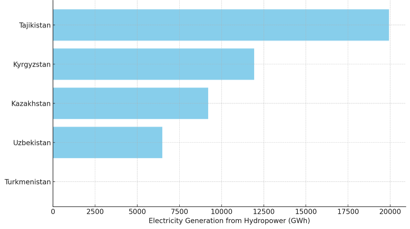
As figure 4 illustrates, hydropower generation data from Turkmenistan by the International Energy Agency confirms regional dominance of Tajikistan and Kyrgyzstan.[18] With nearly 20,000 GWh and 12,000 GWh of generation respectively in 2022, their water-endowed geologic dispositions provide them with significant energy autonomy, often employed as a bargaining tool in battles for seasonal water release.
Figure 4. Hydropower Electricity Generation in Central Asian Countries (2022)
Source: International Energy Agency; Author’s Illustration
Furthermore, Table 1 highlights the dependence that results from this imbalance. Turkmenistan exported 4,529.4 million kWh to Uzbekistan and 813.5 million kWh to Kyrgyzstan and hence is a balancing counter. Tajikistan exported to both Afghanistan and Uzbekistan, and Uzbekistan reciprocally exported 1,425.6 million kWh to Afghanistan.[19] This cross-trading of relations shows that even without a full regional energy market, electricity trade is strong under bilateral arrangements.
Table 1. Central Asia Electricity Trade Snapshot (2022)
| Exporting Country | Importing Country | Volume (million kWh) |
| Turkmenistan | Uzbekistan | 4,529.4 |
| Turkmenistan | Kyrgyzstan | 813.5 |
| Tajikistan | Uzbekistan | 839.4 |
| Uzbekistan | Afghanistan | 1,425.6 |
| Tajikistan | Afghanistan | 1,663.7 |
Source: CAREC Program
The World Bank points out that increased electricity trade in the region, most notably via initiatives such as CASA-1000, has the potential to create up to US$6 billion in economic value by 2030 while reducing carbon emissions by almost 30 million tons.[20] Yet, recurring infrastructure bottlenecks, poor regulatory harmonization, and political and economic priorities of water-energy interlinkages continue to hinder a more resilient and open regional electricity market.
Downstream states dominate agricultural needs, upstream states enjoy hydropower dominion, and inter-state commerce reflects a growing, but tenuous, functional collaboration. To comprehend this landscape is to untangle the geopolitics arithmetic at the heart of Central Asia’s hydropower politics.
Case Study: The Rogun Dam and Hydropower Politics
The Rogun Dam in Tajikistan is a classic example of how development of hydropower in Central Asia is inseparably intertwined with national identity, interregional disparities, and political tension. Conceived for the first time during the Soviet era and revived post-independence, the dam has been framed by the Tajik state as an icon of statehood and sovereignty. In the words of the country’s president, it was famously referred to as ‘a matter of life and death,’ prompting citizens to fund the venture.[21]
This nationalist explanation is in conflict with local interests. Uzbekistan opposes the project vehemently, as it fears that winter-focused water storage for hydropower would divert critical summer irrigation flows downstream.[22] Hydro-economic models indicate that unilateral operation of Rogun could lead to over 30% reductions in irrigation benefits in Uzbekistan and increase regional energy output only slightly.[23]
Aside from economic and technical concerns, Rogun Dam is also increasingly an ideological anchor of Tajik political identity. Féaux de la Croix and Suyarkulova argue that the dam is marketed as a national symbol of unity, idealized in media and political rhetoric as a ‘palace of light’. Dissent is suppressed, and the dam critics are habitually depicted as unpatriotic.[24]
Thus, Rogun Dam summarizes the larger water politics challenge in Central Asia: while hydropower can address internal energy vulnerability, its one-dimensional pursuit tends to increase interstate tensions. Consequently, the Rogun experience demonstrates how infrastructure development projects can exacerbate political divisions when used as tools of sovereignty rather than a platform for regional cooperation.
External Actors and Interests: China and Russia in Central Asia’s Hydropower Politics
In Central Asian political relations over hydropower, Russia and China have emerged as important but rival actors when influencing water and energy geopolitics. The increasing Chinese influence stems from its infrastructure based diplomacy in the Belt and Road Initiative (BRI), while Russia relies on historical loyalty and the dominant role it plays in regional security frameworks.
China’s arrival in Central Asian hydropower is pragmatic. Instead of being part of the most contentious upstream regions like Tajikistan, it has concentrated its investment on downstream countries such as Kazakhstan and Uzbekistan. They have been part of high-profile projects like the 300 MW Moynak power plant in Kazakhstan, built with the assistance of China Development Bank and executed by China International Water and Electric Corporation. This specific strategy has allowed China to avoid inter-state conflict over access to transboundary water resources without compromising regional energy security.[25] Additionally and most significantly is that China has even acted as a mediator for joint Tajik-Uzbek development of hydropower on the Zarafshan River, highlighting its potential as a stabilizer in the region.[26]
Russia, in contrast, relies on a more debated strategy of soft power by means of language, migrant labor, and regional institutions such as the Eurasian Economic Union (EAEU) and Collective Security Treaty Organization (CSTO). Russia has never fulfilled hydropower investment commitments such as the Kambarata project in Kyrgyzstan, which is delayed, illustrating the gap between words and money.[27] Russia’s influence currently relies less on infrastructure building and more on security guarantees as well as traditional alliances.
Both of these powers avoid direct confrontations with transboundary water governing bodies, an articulation of a bilateral, interest-based preference. However, their approach varies: China’s economic soft power reshapes physical infrastructure and commerce, while Russia’s geopolitical clout shapes political inclinations. This dual dynamic characterizes the realm of implicit rivalry, particularly with Beijing’s economic projection broadening in the shadow of Russia’s relative economic decline.[28]
Recent research suggests that Chinese hydropower diplomacy is not entirely selfless; it is rather unclear and dismissive of environmental and social convention. Moreover, its projects into geopolitically contentious areas can further intensify local anger or bypass regional consensus.[29] In contrast, Russia’s more securitized approach has not yet been translated into productive water cooperation, with significant regional institutions like the Shanghai Cooperation Organization being silent about transboundary water management.[30]
Significantly, Central Asian hydro-politics are highly nationalized with countries like Uzbekistan and Tajikistan continuing to assert strong sovereignty over water policy and present inherent barriers to external influence. Neither Russia nor China has been willing to enable controversial upstream-downstream relations, such as the long-standing ones related to the Rogun Dam. Their actions, thus, while regionally significant, are short of leading to the deeper, structural changes required for integrated water diplomacy.
Potential Actions Beneficial for All Parties
To achieve lasting hydropower cooperation in Central Asia, steps must go beyond technocratic fixes and overcome deep-seated political, institutional, and epistemic divides. Regional order remains fragmented under the impact of legacy institutions and conflicting national agendas. Upstream states specifically Tajikistan and Kyrgyzstan pursue hydropower development to end energy deficit, while downstream states like Uzbekistan and Turkmenistan favor irrigation for agriculture, thus creating cyclical water release disputes. To make this shift from this zero-sum thinking, three related strategies are necessary for consideration by these countries.
First, a jointly managed regional water-energy compensation mechanism must be revamped and modernized. Earlier attempts, such as the 1998 Syr Darya agreement, broke down primarily due to the absence of legally binding compensation arrangements and open arbitration. A new version must include seasonal trade-offs, third-party monitoring, and guaranteed compensation in kind or cash. Such a template must also be decoupled from bilateral political leverage to prevent coercion in water diplomacy.[31]
Second, joint investment in small hydro and solar decentralized renewable energy would reduce upstream-downstream dependencies. Uzbekistan and Kazakhstan, which are financially and institutionally better positioned, should co-finance such ventures in Kyrgyzstan and Tajikistan in exchange for reliable water regimes.[32] This approach will decrease the tension while at the same time could bring more stability into the energy sector of countries.
Third, re-establishment of science-policy integration and education reform is a necessity. The water governance in Central Asia is hampered by institutional path dependency and lack of local scientific capacity. A regional based platform for applied research that is synced with national policy requirements would provide the base for sustained collaboration.[33] Lastly, the depoliticization of water governance alongside addressing reasonable development asymmetries can facilitate a cooperative hydropolitical future. Without this shift, Central Asia risks remaining trapped in cycles of crisis-response rather than building resilience.
It is important to mention that certain steps towards regional hydropower collaboration are already taking place. Recent developments in the region’s hydropower landscape include two major projects. The Rogun Hydropower Plant in Tajikistan is at an installed capacity of 3,780 MW, with around 70% of its generated electricity estimated for export to the neighboring countries of Uzbekistan and Kazakhstan.[34] In turn, the Kambarata 1 Hydropower Plant on the Naryn River in Kyrgyzstan has a design capacity of 1,860 MW and, in June 2024, was the subject of a trilateral agreement by Kyrgyzstan, Kazakhstan, and Uzbekistan to jointly develop, finance, and operate the project.[35] These projects reflect both the scale of hydropower ambition in Central Asia and a growing interest in shared regional infrastructure.
Conclusion and Policy Recommendations
The politics of hydropower in Central Asia are a complexly connected netting of historical legacies, geographic inequalities, nationalist policy agendas, and regional interdependence. Whereas energy self-reliance through dam construction is pursued by upstream countries, downstream countries hang on to irrigated farming, which is triggering rival claims to shared rivers. Efforts to set up cooperative mechanisms through institutions like the ICWC, IFAS, and some other multiple bilateral agreements have largely failed to institutionalize sustainable trust and collective accountability. Instead, national interests hold dominance, generally leading to short-term ad hoc bilateral deals at the cost of effective regional planning.
Climate change together with infrastructure deterioration, and demographic growth heighten tensions and make the current course unsustainable. While both China and Russia exert significant influence over the hydropower sector in Central Asia, their engagement remains largely pragmatic and interest-driven rather than leadership-oriented in regional water diplomacy. Instead, the region is caught in a reactive crisis management loop.
To break this cycle, Central Asia must transition its hydropolitics into long-term and inclusive solutions. First, a new water-energy trade model must be negotiated, one premised on enforceable compensation mechanisms, third-party monitoring, and legal certainty. Second, decentralized renewable investment, particularly in energy-poor upstream countries, must be encouraged, with downstream states’ funding repaid with seasonal water predictability. Third, science-policy integration must be institutionalized across the region. This involves funding regionally coordinated research, harmonizing water data systems, and embedding science advisory functions in government water agencies.
Additionally, countries need to carry out the water codes and national policy reforms so that they include the transboundary character of their shared basins and meet international standards of law. Otherwise, the region will be pushed into additional polarization, resource degradation, and wasted economic benefits.
Finally, development of cooperative hydropower is a political necessity rather than a technical issue. Only through concerted planning, joint compromises, and institutional innovation can Central Asia transform water from the source of regional conflict into an instrument of regional stability and prosperity.
About Samira Odinabekova
Samira Odinabekova is an MA student in Economic Governance and Development at the OSCE Academy in Bishkek. She holds a Bachelor’s degree in Global Economics from University of Central Asia. Her areas of interest are at the intersection of economic policy, governance and sustainable development. Samira is interested in finding out more about the role of economic policies in driving long-term growth in developing economies. Her academic qualification and continuous studies equip her with a comprehensive understanding of global economic trends and governance structures.
Address for correspondence:
osamira2001@gmail.com
[1] Kseniia S. Zakharova, “Modern Hydro-Energy Problems in Central Asia,” Post-Soviet Issues 5, no. 3 (2018): 298–308.
[2] Bo Libert and Annukka Lipponen, “Challenges and Opportunities for Transboundary Water Cooperation in Central Asia,” International Journal of Water Resources Development 28, no. 3 (2012): 565–576.
[3] Filippo Menga, Power and Water in Central Asia (Abingdon: Routledge, 2018).
[4] Bezen Balamir Coskun, “Hydropolitics in Central Asia: Towards a Regional Water Regime?,” The Interdisciplinary Journal of International Studies 2 (2004): 80–84, https://core.ac.uk/download/pdf/229012095.pdf.
[5] Ibid., 91–93.
[6] Ibid., 95.
[7] International Crisis Group, Central Asia: Water and Conflict, ICG Asia Report No. 34, May 30, 2002, https://www.files.ethz.ch/isn/28347/034_central_asia_water_conflict.pdf.
[8] Pacific Institute, Water Conflict Chronology, Pacific Institute, https://www.worldwater.org/conflict/list/.
[9] Philip Micklin, The Aral Sea: The Devastation and Partial Rehabilitation of a Great Lake (Berlin: Springer, 2019).
[10] Xiaolei Wang et al., “Reviving the Aral Sea: A Hydro-Eco-Social Perspective,” Earth’s Future 11, no. 11 (2023): e2023EF003657, https://doi.org/10.1029/2023EF003657.
[11] Shlomi Dinar, “The Geographical Dimensions of Hydro-politics: International Freshwater in the Middle East, North Africa, and Central Asia,” Eurasian Geography and Economics 53, no. 1 (2012): 117–121.
[12] Asel Murzakulova, The Impact of Climate Change on Central Asian Hydro-Politics (Bishkek: University of Central Asia, 2023), 4–5.
[13] Ibid., 5–6.
[14] Ibid., 6–7.
[15] World Bank, Level of Water Stress: Freshwater Withdrawal as a Proportion of Available Freshwater Resources (ER.H2O.FWST.ZS), World Development Indicators, accessed October 2025, https://data.worldbank.org/indicator/ER.H2O.FWST.ZS?locations=TM-KZ-KG-TJ-UZ.
[16] World Bank, Annual Freshwater Withdrawals, Agriculture (% of Total Freshwater Withdrawal) – Kazakhstan, Kyrgyz Republic, Tajikistan, Turkmenistan, Uzbekistan, accessed May 22, 2025, https://data.worldbank.org/indicator/ER.H2O.FWAG.ZS?end=2021&locations=KG-TJ-KZ-UZ-TM&start=2000.
[17] United Nations Development Programme (UNDP), Protecting Turkmenistan’s Economic and Social Future from Climate Change: Insights from the Water-Agriculture Nexus in Dashoguz and Ashgabat (Ashgabat: UNDP Turkmenistan, 2024), https://www.undp.org/sites/g/files/zskgke326/files/2024-08/undp-tm-policy_brief_eng-2024.pdf.
[18] International Energy Agency, Electricity Generation Sources, 2022.
[19] CAREC Program, Current State of the Central Asian Unified Energy System, November 2023, https://energy.carecprogram.org/wp-content/uploads/2023/11/Current-state-of-the-Central-Asian-Unified-Energy-System.pdf.
[20] World Bank, “Central Asia Electricity Trade Brings Economic Growth and Fosters Regional Cooperation,” October 20, 2020, https://www.worldbank.org/en/news/feature/2020/10/20/central-asia-electricity-trade-brings-economic-growth-and-fosters-regional-cooperation.
[21] Filippo Menga, “Building a Nation through a Dam: The Case of Rogun in Tajikistan,” Nationalities Papers 43, no. 3 (2015): 479–494, https://doi.org/10.1080/00905992.2014.924489.
[22] Jeanne Féaux de la Croix and Mohira Suyarkulova, “The Rogun Complex: Public Roles and Historic Experiences of Dam-Building in Tajikistan and Kyrgyzstan,” Cahiers d’Asie centrale 25 (2015): 103–132, https://journals.openedition.org/asiecentrale/3123.
[23] Maksud Bekchanov et al., “How Would the Rogun Dam Affect Water and Energy Scarcity in Central Asia?” Water International 40, nos. 5–6 (2015): 856–876, https://doi.org/10.1080/02508060.2015.1051788.
[24] Féaux de la Croix and Suyarkulova, “The Rogun Complex,” 120–122.
[25] Niva Yau, “Chinese Hydroelectric Investments in Central Asia: A Snapshot,” Eurasianet, August 2020.
[26] Ibid.
[27] Benjamin Pohl et al., Rethinking Water in Central Asia: The Costs of Inaction and Benefits of Water Cooperation (Berlin: Adelphi and CAREC, 2017), 17.
[28] Ibid.
[29] Patrick Martens, “The Political Economy of Water Insecurity in Central Asia Given the Belt and Road Initiative,” Central Asian Journal of Water Research 4, no. 1 (2018): 79–94.
[30] Filippo Menga, Power and Water in Central Asia (London: Routledge, 2018), 134–137.
[31] Sergey Zhiltsov, “Politics of Central Asia: Water and Energy Aspect,” Vestnik RUDN, no. 3 (2016): 7–17.
[32] Elena Shadrina, “Renewable Energy in Central Asian Economies: Role in Reducing Regional Energy Insecurity,” ADBI Working Paper Series no. 993 (2019): 20–28.
[33] Iskandar Abdullaev et al., “Current Challenges in Central Asian Water Governance and Their Implications for Research, Higher Education, and Science-Policy Interaction,” Central Asian Journal of Water Research 11, no. 1 (2025): 47–58.
[34] World Bank, Rogun Hydropower Plant Project (HPP) – FAQs (Washington, D.C.: World Bank, 2024), https://www.worldbank.org/en/programs/rogun-hydropower-plant-project/faqs.
[35] “A Tripartite Project on the Joint Construction of the Kambarata-1 HPP Project in Central Asia,” INBO News, June 2024, https://www.inbo-news.org/a-tripartite-project-on-the-joint-construction-of-the-kambarata-1-hpp-project-in-central-asia/.