
Analysis by Alisher Narynbaev

Abstract: This study focuses on developing a universal methodology for day-ahead forecasting of solar photovoltaic power generation, addressing the variability of solar irradiance and its impact on electricity markets. The research aims to enable the selection of optimal forecasting methods based on data availability and quality. The proposed methodology encompasses data analysis, model selection, development, and validation, integrating physical and statistical approaches. Physical models transform solar irradiance into electrical output through sequential mathematical modeling, while statistical models leverage supervised machine learning, specifically Multilayer Perceptron and Gradient Boosting Regression. The methodology was validated using the PVOD dataset from China and operational data from Russian PV plants, achieving normalized root mean square errors of 5.41–6.07% for physical models and 9.5–10.2% for statistical models. Forecasting skill scores of 0.731–0.742 demonstrate superior performance over naive day-ahead forecasts. The approach ensures adaptability to diverse data scenarios, supporting PV plant operators and grid dispatch centers in optimizing bidding strategies within electricity markets, such as Russia’s Wholesale Electricity and Capacity Market. This methodology offers a scalable solution for enhancing the reliability of solar power integration into power systems.
Keywords: energy forecasting, machine learning methods, mathematical models, model chain, numerical weather prediction, photovoltaic power plants, prediction accuracy, renewable energy, PV power forecasting, pvlib, renewable energy, solar radiation
Методика прогнозирования выработки СФЭС на сутки вперёд
Аннотация: Исследование посвящено разработке универсальной методики прогнозирования выработки электроэнергии солнечными фотоэлектрическими станциями на сутки вперёд. Цель исследования — обеспечить выбор оптимальных методов прогнозирования в зависимости от доступности и качества исходных данных. Предложенная методика включает анализ данных, выбор модели, её разработку и верификацию, основываясь на физическом и статистическом подходах. Физические модели пересчитывают значения солнечной радиации в электрическую мощность через последовательное математическое моделирование, тогда как статистические модели используют машинное обучение с учителем, в частности многослойный перцептрон и градиентный бустинг. Методика была проверена на наборе данных PVOD с СЭС, расположенных в Китае, и эксплуатационных данных двух российских фотоэлектрических станций. Нормализованная среднеквадратичная ошибка составила 5,41–6,07% для физических моделей и 9,5–10,2% для статистических моделей. Показатели качества прогнозирования, равные 0,731–0,742, продемонстрировали превосходство над наивными инерционными прогнозами на сутки вперёд. Методика обеспечивает адаптивность к различным сценариям данных, предлагает масштабируемое решение для повышения надёжности интеграции солнечных электростанций в энергосистемы.
Ключевые слова: возобновляемая энергетика, математические модели, методы машинного обучения, последовательное моделирование, прогнозирование выработки СЭС, прогнозирование выработки энергии, pvlib, солнечное излучение, солнечные электростанции, точность прогноза, численные прогнозы погоды
Introduction
A global trend in power generation is the growing share of renewable energy sources (RES), particularly solar photovoltaic (PV) plants. A defining challenge of RES systems is the variability of their energy supply, driven in PV systems by fluctuations in solar irradiance. Solar irradiance consists of a deterministic component—predictable via astronomical equations—and a stochastic component, which depends on atmospheric factors such as cloud cover, temperature, humidity, wind speed, and precipitation.
The complexity of accurately forecasting PV output has spurred extensive research, motivated by the global expansion of solar energy and the necessity for its reliable integration into existing power systems. This has led to the development of energy meteorology[1],[2] —an interdisciplinary field addressing RES forecasting across timescales from minutes to decades.
Short-term forecasting, particularly for day-ahead markets (DAM), is of primary importance due to its role in electricity trading and dispatching. Accurate forecasts are crucial for PV plant operators and grid dispatch centers. In Russia’s Wholesale Electricity and Capacity Market (WECM), forecasts guide operational planning and price bid submissions.
However, PV output forecasting under WECM conditions remains insufficiently addressed. Many forecasts rely on expert judgment or plant-specific methods that lack scalability and adaptability. This underscores the urgent need for a universal forecasting methodology suitable for both existing and future PV plants under diverse data conditions.
Day-Ahead Solar Power Forecasting Methodology
The forecasting of solar irradiance and the subsequent prediction of electricity generation by solar power plants is currently attracting significant interest from researchers worldwide. As a result, a vast array of diverse approaches to solving this problem has been developed. However, for each specific case, one typically has to choose from a limited set of established methodologies available to date—or develop a custom solution. Most often, the limitations stem from the characteristics of the retrospective input data or even the complete lack thereof.
Available computational resources also play an important role in addressing this issue. Among the main criteria for selecting a forecasting approach for PV power plants, the following can be highlighted:
– Characteristics of input data (volume and quality of the dataset, its resolution, and completeness)
– Target forecasting horizon (ultra-short-term, short-term, medium-term, or long-term)
– Forecast resolution (depending on the application domain, different temporal resolutions may be required for the same forecasting horizon)
– Required type of forecast data representation (deterministic forecasts or probabilistic forecasts).
The key stages of the methodology proposed in this work include: analyzing the available input data; selecting, constructing, and validating mathematical models; and implementing these models into operational use (Fig. 1).
Figure 1. Stages of PV Power Forecasting Methodology

Source: Generated by the Author
The method or variant for solving the forecasting problem of PV power plant output is determined based on the requirements of the end user. Forecast information can be regarded as a type of product, shaped by specific criteria.
This study examines day-ahead forecasting for large-scale PV plants integrated into power systems and electricity markets. As most trading occurs in the DAM, hourly forecasts are essential. Deviations from actual output are resolved in the balancing market. PV operators submit price bids under regulatory constraints, which vary by country and may depend on support schemes. Forecast models must comply with standards defined by horizon, lead time, granularity, and update frequency.
Source Data Analysis
To select optimal forecasting methods, it is essential to analyze input data, which falls into three categories: on-site measurements, external data (e.g., numerical weather prediction (NWP), satellite imagery), and PV plant technical specifications.
Local solar irradiance and output data support performance monitoring and model development. These are typically collected via Automated Commercial Metering Systems, which also measure active/reactive power.
Key environmental parameters—solar irradiance, module and air temperature, and wind speed—must be recorded at representative locations per standard practice.
For forecast horizons over 6 hours, NWP is the most reliable method, though its accuracy depends on the chosen model and site-specific factors. [3],[4],[5],[6],[7],[8]
The most reliable publicly accessible global NWP models include:
- GFS (NOAA): 13 km resolution, 127 vertical layers, 4 forecasts/day (00, 06, 12, 18 UTC).[9]
- ICON (DWD & MPI): 13 km resolution, 90 levels (up to 75 km), 4 forecasts/day.[10]
- ARPEGE40 (Meteo-France): 40 km resolution, 105 levels, 4-day horizon, hourly output for first 48 h, updated 4 times daily.[11]
These models are widely used for solar forecasting due to their high spatial resolution and regular update cycles.
A preliminary analysis of the quality of the available input data is recommended to be conducted by verifying the following conditions:
, (1)
, (2)
where and
denote the source (available) and required data discretization, respectively;
and
represent the available and required amounts of data.
The results of the input data quality assessment are proposed to be classified into one of the following three evaluation categories:
- Strict compliance — both conditions (1) and (2) are satisfied, and the data meet the adequacy and reliability (sufficient quality) criteria.
- Moderate compliance — only condition (1) is satisfied, along with the adequacy and reliability criteria.
- Non-compliance — condition (1) is not satisfied, and the adequacy and reliability criteria are not met.
Following the evaluation of local measurement data, the next steps in selecting an appropriate forecasting approach involve verifying the availability of the technical specifications of the PV power plant and the archival data of numerical weather prediction (NWP) models.
Development of Mathematical Forecasting Models for PV Power Output
Forecasting approach selection depends on data completeness and is divided into physical and statistical categories. The core modeling task is the “irradiance-to-power” conversion—transforming solar input into electrical output.
Statistical methods rely on historical data and regression models; physical methods simulate energy conversion based on sequential system modeling. Depending on data availability, 33 scenarios are defined: 6 physical (Table 1) and 2 statistical variants (Table 2).
If both Conditions (1) and (2) are met (i.e., input data completeness is confirmed), the primary task becomes a quality assessment of local measurements, which includes verifying the presence of mandatory parameters such as Global Horizontal Irradiance (GHI) and PV plant output power (PPV) within the input data set. A lack or incompleteness of technical specifications of the PV system necessitates the use of simplified forecasting methods. The presence or absence of archived NWP data affects the feasibility of forecast calibration (post-processing).
With complete data, especially under Scenarios 1–2 and 28–30, combining physical and statistical models is optimal, as model performance can’t be predetermined without validation.
The complete absence of input data in practical applications is highly unlikely. However, even in such cases, the forecasting problem remains solvable, albeit with significant assumptions and comparatively high error margins. A simplified physical forecasting model may be expressed by the following equation:

where is the PV plant power forecast; GTI is the forecasted value of Global Tilted Irradiance;
denotes the power output of a PV array under Standard Test Conditions (STC);
— the PV cell temperature;
is the temperature coefficient of the PV module, which may be assumed as -0.4%/°C in the absence of specific input data;
is the inverter efficiency.
Table 1. Scenarios Leading to Physical Approach of PV Power Forecast
| No. of scenario | Local measurements data | Technical data of PV power plant | NWP data archive | Method of forecast | |||
| GHI | PPV | ||||||
| 1 | + | + | + | + | + | + | Physical method with post-processing |
| 2 | + | + | – | + | + | + | |
| 3 | + | – | + | + | + | + | Physical method with simplified post-processing |
| 4 | + | – | – | – | + | + | |
| 5 | + | – | – | + | + | + | |
| 6 | + | – | + | – | + | + | |
| 7 | + | + | + | + | + | – | Physical method without post-processing |
| 8 | + | + | – | + | + | – | |
| 9 | + | + | – | – | + | + | |
| 10 | + | – | + | + | + | – | |
| 11 | + | – | – | – | + | – | |
| 12 | + | – | – | + | + | – | |
| 13 | + | – | + | – | + | – | |
| 14 | – | – | – | – | + | – | |
| 15 | + | + | + | – | – | + | Simplified physical method with post-processing |
| 16 | + | + | – | – | – | + | |
| 17 | + | – | – | – | – | + | Simplified physical method with simplified post-processing |
| 18 | + | – | – | + | – | + | |
| 19 | + | – | + | – | – | + | |
| 20 | + | – | + | + | + | + | |
| 21 | + | – | – | – | – | – | Simplified physical method without post-processing |
| 22 | + | – | – | + | – | – | |
| 23 | + | – | + | – | – | – | |
| 24 | + | – | + | + | – | – | |
| 25 | + | + | – | – | – | – | |
| 26 | + | + | + | – | – | – | |
| 27 | – | – | – | – | – | – | |
Table 2. Scenarios Leading to Statistical Approach of PV Power Forecast
| No. of scenario | Local measurements data | Technical data of PV power plant | NWP data archive | Method of forecast | |||
| GHI | PPV | ||||||
| 28 | + | + | + | + | + | + | Regression model with post-processing |
| 29 | + | + | – | + | – | + | |
| 30 | + | + | + | + | – | + | |
| 31 | + | + | + | + | – | – | Regression model without post-processing |
| 32 | + | + | – | + | – | – | |
| 33 | + | + | + | + | + | – | |
Physical Forecasting Method
The mathematical modeling of the physical process of solar energy conversion is a multi-stage procedure. Unlike statistical methods, where uncertainty regarding the choice of computational model arises only once, the physical modeling process involves multiple decision points at each stage. Each of these decisions can result in different combinations of models, ultimately leading to a variety of modeling frameworks. The conceptual structure of the physical forecasting method for PV system output, based on sequential mathematical modeling, is illustrated in Fig. 2.
Figure 2. The Concept of Physical PV Power Forecasting Approach

Source: Generated by the Author
In solar forecasting literature, a “model chain” denotes a fixed sequence of physical models, determined by input data availability.[12],[13] Each stage is non-interchangeable. Selecting optimal models resembles hyperparameter tuning in machine learning, and a key advantage of physical models is their independence from historical data—allowing deployment before plant operation begins.
When solar irradiance data are absent from general forecasts, GHI must be estimated using meteorological parameters (e.g., air temperature (Tair), relative humidity (RH), cloud cover (C), wind speed (WS) and direction (WD), precipitation (Pr), atmospheric pressure P, etc.), adding uncertainty. If irradiance is provided, this step is skipped.
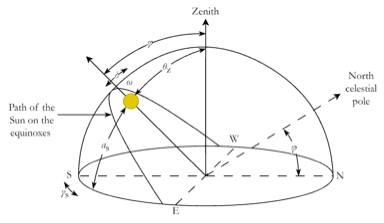
Model selection is based on forecast accuracy, computational cost, and usage prevalence. The proposed physical forecasting approach uses the Python library pvlib[14]. According to the conceptual diagram shown in Fig. 2, the approach starts with solar position (Fig. 3) calculation and GHI decomposition using solar elevation angle α, zenith angle θz, solar azimuth angle γs, and hour angle ω:[15]

where is latitude;
denotes the solar inclination angle;
represents the number of the day in the year, TST is True Solar Time at the longitude
.
The decomposition of GHI into its direct (BHI – Beam Horizontal Irradiance) and diffuse (DHI – Diffuse Horizontal Irradiance) components is performed using appropriate decomposition models. These quantities are interrelated through the following expression:

where DNI is the Direct Normal Irradiance, i.e., the beam component of solar radiation incident on a surface that is perpendicular to the direction of the solar rays.
Figure 3. Position of the Sun in the Sky Relative to the Solar Angles.[16]
Source: Generated by the Author
From the standpoint of forecasting the power output of PV systems, particular attention should be given to decomposition models that rely on input variables available in enhanced meteorological forecasts (or those that can be derived from such data). A list of such models is presented in Figure 4 (Stage 1).
The second stage of the physical forecasting method consists in the transposition of GHI into values of total solar irradiance (GTI – Global Tilted Irradiance) on an arbitrarily oriented and tilted surface, as the tilt angle of PV modules is typically non-zero. These transposition models are based on the output parameters obtained from the previous step—namely, BHI and DHI:

where Rd the conversion coefficient for the diffuse component of solar irradiance; is the surface albedo of the ground; and Rr is the conversion coefficient for the reflected component, which is often assumed to be isotropic in practical applications.
The main distinguishing feature of models for converting GHI to GTI lies in their treatment of Rd. Isotropy and anisotropy in this context refer, respectively, to the assumption of uniform sky-dome diffusion of solar irradiance and the accounting for the brightness of the circumsolar region. The recommended transposition models are summarized in Figure 4 (Stage 2).
At the third stage, it is necessary to model the temperature ofPV cells, which significantly affects the performance characteristics of the photovoltaic converters. The cell temperature can be considered a function of the ambient air temperature (Tamb) and GTI:[17], [18]

where TNOCT is the nominal operating temperature of a PV cell at GTINOCT = 800 W/m2; Tamb = 20°C.
Figure 4. Physical PV Power Forecasting Approach as the Model Chain

Source: Generated by the Author
Mathematical models of PV modules describe the effects of GTI and Tamb, which significantly influence the process of photovoltaic energy conversion. The modeling carried out in the fourth stage relies on the single-diode model of the PV cell, according to which the current IPV is calculated using the following expression:[19]

where IL is the photocurrent, which directly depends on the effective value of GTI; I0 is the diode reverse saturation current; a = NkTPV cell (where N is the diode ideality factor, k is Boltzmann’s constant [1.380649⋅10−23 J/K]; Rs and Rsh are the shunt resistance and series resistance, respectively.
In the fifth stage, solar inverter mathematical models are employed to estimate DC-AC conversion losses as well as power and voltage limitations. Inverter efficiency data are usually presented in technical documentation as performance curves at three or more voltage levels. The models shown in Figure 4 facilitate the transformation of such performance curves into analytical expressions. One of the most widely used models, proposed by D. L. King, is formulated as follows:[20]

where and
are the inverter input voltage and power;
is the rated AC output power of the inverter;
и
are the reference voltage and power at which the inverter achieves
;
is the minimum DC power required to initiate the inversion process; C0, C1, C2, C3 represent empirical coefficients characterizing the internal behavior and design-specific properties of the inverter.
In sequential PV modeling, irradiance and temperature are known from prior steps. Remaining inverter parameters are derived from the California Energy Commission database or estimated using pvlib and datasheet values. Losses depend on available system data. While geometric shading (e.g., row self-shading) can be calculated, cloud-induced shading requires complex models unsuitable for day-ahead forecasting due to low-resolution weather data. If PV array layout is unknown, shading is ignored or simplified by neglecting diffuse loss. Cable and transformer losses are estimated via standard voltage drop and project specs. Additional losses—soiling, mismatch, and light-induced degradation (LID)—can be considered if sufficient input data exist. The proposed physical method accounts for these effects when data permit.
The five modeling stages include 22 total models, which selection was based on reviews of peer-reviewed literature and industry reports, focusing on the most frequently cited and validated models within each of the five modeling stages. Each model is assigned a numeric ID as shown in Figure 4, enabling combinations to be encoded as five-digit sequences (e.g., 11111 represents the Erbs, Liu-Jordan, Ross, De Soto, and King models). The total number of unique combinations is 5×5×5×4×3 = 1500. To identify the optimal set, an exhaustive search with Root Mean Square Error (RMSE) evaluation is proposed; the combination yielding the lowest RMSE is selected.
Statistical Forecasting Method
The statistical method for PV output forecasting is based on the hypothesis of a correlation between power generation and meteorological parameters. This concept is shown in Figure 5. The composition of input data is constrained by the type of regression model applied.
In direct forecast models, the target variable is PV output power, while the predictors are meteorological features. Converting solar irradiance into PV output power is thus a special case of regression analysis. Most implementations rely on supervised machine learning.
A review of relevant studies highlights two main findings:
- Data preprocessing and predictor selection are more critical than model choice.
- The most effective algorithms are the Multilayer Perceptron (MLP) and Gradient Boosting Regression (GBR).[21]
An MLP typically includes an input layer, one or more hidden layers, and an output layer. Each neuron computes a weighted sum of inputs, applies a threshold, and passes the result through an activation function.
GBR constructs an ensemble of weak learners, typically decision trees, in a sequential manner. Each tree attempts to predict the residuals of the ensemble’s previous output. The process is repeated in order to minimize prediction error.
Preprocessing steps include anomaly detection, feature selection, normalization, and encoding of categorical variables. Model performance also depends heavily on hyperparameter tuning—adjusting learning rate, depth, and regularization before training.
Figure 5. The Concept of Statistical PV Power Forecasting Approach

Source: Generated by the Author
Verification of Forecasting Models
Forecast accuracy in solar energy is evaluated using various quantitative metrics—over 18 are cited in the literature. [22] The most common are Root Mean Square Error (RMSE) and Mean Absolute Error (MAE), which assess overall predictive accuracy. Other important metrics include Mean Bias Error (MBE), forecasting skill score (s), and variance, which evaluate bias and uncertainty.
Most solar forecasting studies use deterministic models that provide a single predicted value per time step. For such models, MAE, RMSE, MBE, and Mean Absolute Percentage Error (MAPE) are standard accuracy indicators.
Given a dataset of l pairs of actual and predicted PV outputs, these metrics are formally defined, including the Kolmogorov-Smirnov Integral (KSI), which compares empirical cumulative distributions. RMSE, MAE, and KSI are negatively oriented (lower is better), while MBE is centered on zero, with positive values indicating overestimation and negative values indicating underestimation.
Unlike classical meteorology, solar forecasting often involves normalizing metrics—typically by rated PV plant capacity —to allow fair comparison across different systems and scales:

where s is forecasting skill score (values closer to 1 indicating higher forecast accuracy), while RMSEf and RMSEr represent root mean square errors of forecast and baseline model (usually it is a persistence model), respectively.
Forecasting PV Output Using the Proposed Methodology
The proposed physical forecasting method was validated using the open PVOD dataset[23], which contains 15-minute interval meteorological and technical data from 10 PV plants in Hebei, China. The experiments followed Scenario No. 10 from Table 1—corresponding to an uncalibrated physical model. PV plants No. 1 (6.6 MW) and No. 2 (20 MW) were selected. Since GHI and DHI values were provided, the simulation required only four stages, omitting irradiance decomposition.
For Plant 1 (Fig. 6, a), the best model combination was 1211 (Liu & Jordan, Faiman, De Soto, King), yielding an nRMSE of 5.41%. The worst was 4211 (Reindl instead of Liu & Jordan), with nRMSE = 6.71%. For Plant 2 (Fig. 6, b), 1511 (Liu & Jordan, PVsyst, De Soto, King) was optimal at 6.07% of nRMSE, while 4511 (with Reindl) yielded 7.28%. Modelling inaccuracies can significantly overestimate output—normalized mean bias error (nMBE) reached 2.56% with suboptimal models, and 5.18% with a simplified approach.
The statistical method was applied to two Russian PV plants—Neftezavodskaya (20 MW) and Krasnoarmeyskaya (10 MW) in Volgograd—using hourly generation data from 01.09.2021 to 01.09.2023. Data preprocessing stages contained filtering (all the data rows where θz > 80° were removed. Zero hourly output power values during daytime were filtered as well.) and concatenation with the NWP forecasts data based on the dates. Feature selection was performed via correlation analysis and recursive feature elimination. The MLP and GBR machine learning models were trained with the input features included θz, γs, and ICON-based forecasts of GHI, Tamb, RH, Pr, following Scenario 2 (calibrated regression). The training period comprised 80% of the total dataset, while the remaining 20% was used for validation. Models hyperparameters were tuned using grid search and 5-fold cross-validation. GBR showed slightly better accuracy: 9.5% (Neftezavodskaya) and 10.2% of nRMSE (Krasnoarmeyskaya), as seen in Fig. 7. However, the difference from MLP was marginal (Fig. 7). Model forecasting skill score metrics equal to 0.742 (Neftezavodskaya), and 0.731 (Krasnoarmeyskaya) demonstrate superior performance over day-ahead naive forecasts, confirming the models’ reliability for day-ahead PV output forecasting.
According to the WECM rules in Russia, price bids for the following day must be submitted by participants before 13:30 Moscow time on the current day. The forecasting in this case can be categorized as short-term, as it has lead time of 10.5 h and a forecasting horizon of 36 h. Thus, output data from the ICON forecasts issued at 06 UTC can be utilized for the formation of the price bid for PV power plants[24].
Although only MLP and GBR were used in this study due to their simplicity, effectiveness, and lower data volume requirements, future work will explore deep learning architectures such as LSTM and Transformer networks. These are particularly promising for handling sequential weather patterns and multi-step forecasting but require longer historical datasets and more extensive tuning.

Currently, most commercial PV power forecasting solutions (e.g., Solcast, SolarAnywhere) rely on proprietary hybrid models combining physics-based estimation with machine learning correction layers. Although a direct comparison was not possible due to data access limitations, the performance metrics reported in this study are in line with published results for comparable systems.[25]
Figure 7. Statistical Approach. Measured and Forecasted PPV Hourly Averages of Krasnoarmeyskaya PV Plant During a Partly Cloudy Day (а) and of Neftezavodskaya PV Plant During a Clear Day

а) 12.08.2023 б) 29.08.2023
Source: Generated by the Author
Conclusion
The study developed a structured methodology for day-ahead PV power forecasting, comprising stages of data analysis, method selection, model development, and validation. The approach enables informed decisions on forecasting techniques based on the completeness and quality of input data.
Two forecasting methods were proposed and tested: a physical method and a statistical method. The physical approach involves sequential mathematical modeling to convert solar irradiance into electrical power. The statistical approach employs supervised machine learning models, specifically multilayer perceptron and gradient boosting regression.
Both methods demonstrated accuracy and applicability. Mathematical models for converting solar radiation to electric power were constructed by identifying optimal combinations of sub-models of a “model chain”. The statistical method was validated using data from PV plants operating in the Russian Wholesale Electricity Market.
Forecast models incorporating Russian Day-Ahead Market bidding requirements were built using supervised learning. The best statistical model achieved a normalized root mean square error of 9.5%.
About Alisher Narynbaev
Alisher Narynbaev is an assistant lecturer at the Department of Hydropower and Renewable Energy Sources, National Research University “MPEI”. In 2024, he defended his candidate thesis “Development of a Methodology for Forecasting Electricity Generation by Solar Photovoltaic Stations” in the specialty “Energy Systems and Complexes”. His research interests include methods for renewable energy forecasting and optimising the operating modes of hybrid energy systems.
Address for correspondence:
[1] T. Reindl, W. Walsh, Z. Yanqin, and M. Bieri, “Energy Meteorology for Accurate Forecasting of PV Power Output on Different Time Horizons,” Energy Procedia 130 (2017): 130–38.
[2] S. V. Kiseleva, N. V. Lisitskaya, and S. E. Frid, “Photovoltaic Power Forecasting: Basic Approaches and Features,” Alternative Energy and Ecology (ISJAEE), no. 24–42 (2020). (In Russian).
[3] A. Sabadus, R. Blaga, S. M. Hategan, D. Calinoiu, E. Paulescu, O. Mares, and V. Badescu, “A Cross-Sectional Survey of Deterministic PV Power Forecasting: Progress and Limitations in Current Approaches,” Renewable Energy (2024): Article 120385.
[4] D. Yang, J. Kleissl, C. A. Gueymard, H. T. C. Pedro, and C. F. M. Coimbra, “History and Trends in Solar Irradiance and PV Power Forecasting: A Preliminary Assessment and Review Using Text Mining,” Solar Energy 168 (2018): 60–101.
[5] Jan Kleissl, Solar Energy Forecasting and Resource Assessment (Academic Press, 2013).
[6] V. Kallio Myers, A. Riihelä, D. Schoenach, E. Gregow, T. Carlund, and A. V. Lindfors, “Comparison of Irradiance Forecasts from Operational NWP Model and Satellite Based Estimates over Fennoscandia,” Meteorological Applications 29 (2022): e2051.
[7] V. E. Larson, “Forecasting Solar Irradiance with Numerical Weather Prediction Models,” in Solar Energy Forecasting and Resource Assessment (Academic Press, 2013), 299–318.
[8] J. Huang, L. J. Rikus, Y. Qin, and J. Katzfey, “Assessing Model Performance of Daily Solar Irradiance Forecasts over Australia,” Solar Energy 176 (2018): 615–26.
[9] National Centers for Environmental Information (NCEI), “Global Forecast Models,” accessed May 11, 2025, https://www.ncei.noaa.gov/products/weather-climate-models/global-forecast.
[10] Deutscher Wetterdienst, “NWP Forecast Data,” accessed May 11, 2025, https://www.dwd.de/EN/ourservices/nwp_forecast_data/nwp_forecast_data.html.
[11] A. Reiß, “Global Verification of Incoming Shortwave Radiation for Several Weather Forecast Models and Different Model Combinations” (Meteoblue, 2021), https://content.meteoblue.com/assets/pdfs/Thesis_Alexandra_Rei%C3%9F.pdf.
[12] M. J. Mayer and G. Gróf, “Extensive Comparison of Physical Models for Photovoltaic Power Forecasting,” Applied Energy 283 (2021): 116239.
[13] R. Urraca, T. Huld, A. V. Lindfors, A. Riihelä, F. J. Martinez de Pison, and A. Sanz Garcia, “Quantifying the Amplified Bias of PV System Simulations due to Uncertainties in Solar Radiation Estimates,” Solar Energy 176 (2018): 663–77.
[14] W. F. Holmgren, C. W. Hansen, and M. A. Mikofski, “pvlib python: A Python Package for Modeling Solar Energy Systems,” Journal of Open Source Software 3, no. 31 (2018): 884.
[15] R. Foster, M. Ghassemi, and A. Cota, Solar Energy, 10th ed. (CRC Press, 2009).
[16] Ibid.
[17] A. G. Ross, “Flat-Plate Photovoltaic Module and Array Engineering,” in Proceedings of the 1982 Annual Meeting of the American Section of the International Solar Energy Society (1982), 909–18.
[18] M. K. Fuentes, “A Simplified Thermal Model for Flat-Plate Photovoltaic Arrays” (Tech. Rep., Sandia National Laboratories, Albuquerque, NM, 1987).
[19] W. D. Soto, S. A. Klein, and W. A. Beckman, “Improvement and Validation of a Model for Photovoltaic Array Performance,” Solar Energy 80, no. 1 (2006): 78–88.
[20] D. L. King, S. Gonzalez, G. M. Galbraith, and W. E. Boyson, “Performance Model for Grid-Connected Photovoltaic Inverters,” Sandia National Laboratories Report SAND2003-XXX (2007).
[21] S. A. Hamad, M. A. Ghalib, A. Munshi, M. Alotaibi, and M. A. Ebied, “Evaluating Machine Learning Models Comprehensively for Predicting Maximum Power from Photovoltaic Systems,” Scientific Reports 15, no. 1 (2025): 10750.
[22] D. Markovics and M. J. Mayer, “Comparison of Machine Learning Methods for Photovoltaic Power Forecasting Based on Numerical Weather Prediction,” Renewable and Sustainable Energy Reviews 161 (2022): 112364.
[23] T. Yao, J. Wang, H. Wu, P. Zhang, S. Li, Y. Wang, X. Chi, and M. Shi, “PVOD v1.0: A Photovoltaic Power Output Dataset,” Science Data Bank (2021).
[24] A. F. Narynbaev, V. A. Kremer, and A. G. Vaskov, “Evaluating Day-Ahead Solar Radiation Forecasts from ICON, GFS, and MeteoFrance Global NWP Models,” Applied Solar Energy 60 (2024): 491–500.
[25] J. M. Bright, “Solcast: Validation of a Satellite-Derived Solar Irradiance Dataset,” Solar Energy 189 (2019): 435–49.